Author: admin

  • Drogues : Question de traitement et de demande

    Drogues : Question de traitement et de demande

    Le 5e jour d’étude sur le projet de loi C-10 au Comité sénatorial des affaires juridiques et constitutionnelles a aujourd’hui abordé de près la question de la consommation de substances et du trafic de drogues illicites.

    Ce qui fut marquant, c’est que la majorité des témoins s’est exprimée en faveur d’une approche davantage axée sur le traitement des toxicomanes que sur leurcriminalisation.

    Une approche axée sur le traitement

    Le Surintendant Eric Slinn, directeur de la sous-direction des drogues de la GRC et Barry MacKnight de l’Association canadienne de chefs de police étaient d’accord pour dire que les mesures répressives telles qu’élaborées dans le C-10 ne sont pas suffisantes pour lutter contre les crimes liés aux drogues. Selon MacKnight, « le C-10 n’est pas une panacée; il faut une approche équilibrée et globale. L’élément traitement est essentiel ».

    MacKnight citait également les approches de santé et de réduction des méfaits, tel que le projet Insite, en tant qu’approches potentiellement complémentaires aux programmes de traitement et dont il faudrait davantage discuter.

    Rebecca Jesseman du Centre canadien de lutte contre l’alcoolisme et les toxicomaniess’exprimait elle aussi en faveur d’une meilleure allocation des ressources envers les traitements pour les utilisateurs de drogues. Jesseman, cependant, soulevait plusieurs préoccupations quant à l’efficacité et aux résultats des programmes judiciaires de traitement des toxicomanes présentement en vigueur dans plusieurs communautés au Canada. (Programmes servants, entre autres, d’échappatoire aux peines minimales obligatoires, un sujet dont j’ai déjà discuté en détail ici.)

    Elle nous rappelait, qu’outre le fait que la plupart des gens ayant des démêlés judiciaires n’auront pas accès à de tels programmes—femmes et autochtones tout particulièrement—les « résultats de ces programmes sont d’ailleurs très variables et ne sont pas basés sur des faits probants ».

    Une demande qui perdure

    Par contre, c’est le sénateur Joyal, en lisant à voix haute une lettre signée par quatre anciens procureurs généraux de la Colombie-Britannique réclamant la légalisation du cannabis, qui a su poser la question la plus poussée de la rencontre :

    Marijuana
    Marijuana

    « La lutte contre la drogue s’est avérée inefficace jusque lors, alors ne faudrait-il pas peut-être considérer que s’il y a des drogues, c’est parce qu’il y a une demande »?

    Certes, la Coalition canadienne des politiques sur les drogues aurait pu en dire long sur cette question. Pourtant, Donald MacPherson, le directeur de la CCPD s’est fait refuser une audience auprès du comité et n’y paraitra donc pas.

    Toutefois, une réponse partielle à cette question est survenue plus tard en soirée lorsque Heather Clark, la collègue de Mme Jesseman, offrait la précision suivante : « Les recherches démontrent que si on limite la disponibilité d’une substance, les utilisateurs de drogues auront recours à d’autres substances ».

  • Sécurité publique et fondements de la loi

    Sécurité publique et fondements de la loi

    Aujourd’hui le comité du Sénat qui étudie le projet de loi C-10 s’est axé sur les modifications apportées par ce projet aux demandes de transfèrement des délinquants Canadiens condamnés à l’étranger. Les échanges entre témoins et sénateurs ont dressé un portrait particulièrement saisissant de la critique de cette partie 3 du projet de loi.

    Tel que le disait ce matin l’avocat John Conroy, en somme, « il semble y avoir un mal entendu profond de la part du gouvernement quant aux objectifs fondamentaux de la loi au Canada. »

    Ce qui est en question c’est une augmentation du pouvoir discrétionnaire du ministre de refuser les demandes de transfèrements de délinquants Canadiens à l’étranger sans avoir à donner de justifications claires. Comme le remarquait Nathalie Des Rosiers, avocate générale de l’Association canadienne des libertés civiles, le libellé actuel du projet de loi, « selon le point de vue du ministre », constitue un choix de mot qui n’est pas digne de la loi. Selon l’article 1 de la Charte, de telles décisions doivent être faites “tel que prescrites par la loi” et non tel qu’issues d’opinions particulières, ajoutait-elle.

    Certes, l’intention du gouvernement dans cette partie du projet de loi serait d’accroître l’importance accordée à la sécurité publique dans les décisions d’attribution ou de non attribution de ces transfèrements. Toutefois, le problème soulevé par cette intention, disait Fannie Lafontaine, professeure de droit à l’Université Laval, c’est que cela fait fi des fondements mêmes de la loi canadienne. En d’autres mots, les fondements de la loi canadienne sont clairs en cette matière : l’objectif de la sécurité publique est mieux servi par le rapatriement d’un Canadien condamné à l’étranger.

    Qu’un délinquant Canadien soit rapatrié ou non, il doit rentrer au Canada, par moyen de déportation, suite à avoir purgé sa peine complète.

    CP
    CP

    Alors la question n’est pas à savoir si nous souhaitons réinsérer le délinquant au sein de la population générale, mais bien comment nous voulons que ça se fasse.

    Souhaitons-nous que le délinquant complète sa peine au Canada, où nous disposons de tout un système de contrôle correctionnel afin d’évaluer le risque de récidive chez le délinquant, des mesures de surveillance en place pour assurer des suivis, ainsi que des programmes de réhabilitation et de réinsertion spécialisés? Ou bien souhaitons-nous qu’il purge sa peine complète et rentre au Canada, sans évaluation de risque de récidive, sans suivi, sans surveillance et même sans dossier criminel canadien?

    Pour M. Conroy, le choix est tout à fait simple : les services correctionnels sont mieux placés que le ministre pour évaluer le risque de récidive des délinquants.

    « C’est comme si le ministre n’a pas foi dans son propre ministère », concluait-t-il.

  • Challenging prohibition: a missing perspective

    Challenging prohibition: a missing perspective

    Tonight the Senate Committee on Legal and Constitutional affairs heard from a huge variety of witnesses, from researchers at the Canadian Center on Substance Abuse to Chief Ron Evans of the Norway House First Nation to representatives of the RCMP.

    In all, ten witnesses were called. Nearly every witness—including those representing law enforcement—made it clear that a variety of approaches are required to stem drug-related crime, not just enforcement.

    However, not a single witness dared question the efficacy of drug prohibition itself. This important framework was in fact almost entirely missing from the discussion. And with the Senate declining to hear from the Canadian Drug Policy Coalition’s Director, Donald Macpherson, it is unclear if such a perspective will be raised in the hearings to come.

    Witness after witness in today’s hearings sung the praises of harsher sentencing for drug crimes, even though there is no evidence that this approach works to either deter or rehabilitate individuals. What we do know is that prohibition continues to fill the coffers of organized criminals.

    Gwendolyne Landolt, Vice President of the Drug Prevention Network of Canada, went so far as to claim that prohibition was indeed a successful policy given that alcohol consumption decreased during the prohibition era in the United States from 1920 to 1933. However, as evidenced by a recent report from the Health Officers Council of British Columbia, this is actually like comparing apples to oranges.

    During prohibition, there may have been a decrease in alcohol consumption, but there was in fact a marked increase in organized crime.

    After prohibition, alcohol was not only legalized, but drinking was heavily promoted by the alcohol industry.

Senator Joyal came closest to questioning this failed prohibition approach when he brought up the open letter recently signed by four former BC attorneys general.

    In that letter, the attorneys general compare the violence and bloodshed during prohibition to the current situation in British Columbia, where organized crime turns a healthy profit through marijuana and synthetic drugs.

Despite the misinformation put forward by witnesses such as Ms. Landolt, who claimed that young people who use drugs can never hope to participate in society, the fact is that substance use takes place on a spectrum, ranging from beneficial, through recreational, to problematic. The majority of Canadians who use or have used drugs do not suffer from problematic effects or harmful abuse. Perhaps it’s time our lawmakers took these facts into consideration, and produced policy based on health, regulation and human rights.


  • Discretion in Bill C-10 Part II: Ministers versus Judges

    Discretion in Bill C-10 Part II: Ministers versus Judges

    Today’s Senate committee hearings into Bill C-10 focused on testimony from three lawyers regarding amendments to the International Transfer of Prisoners Act: Nathalie Des Rosiers, General Counsel of the Canadian Civil Liberties Association, Fannie Lafontaine, a law professor at the University of Laval, and John Conroy, a lawyer in the Fraser Valley.

    These lawyers were very concerned with the expansion of ministerial discretion over the repatriation of Canadian prisoners. They argued that the bill would make it easier for a minister to deny the transfer of prisoners for what amounts to arbitrary reasons.

    Mr. Conroy brought up the example of the Goulet case, where Minister Toews’ decision not to repatriate a prisoner convicted of a drug crime was deemed unreasonable by a federal judge. The decision cited twelve previous ministerial decisions since 2008 that were also deemed unreasonable, showing a problematic pattern in politicized decision-making over prisoner transfer. In these cases, the minister ignored the evidence put forward by officials at the Ministry of Public Safety; as Mr. Conroy put it, “It’s as if the minister doesn’t trust his own ministry.”

    The three lawyers made it clear that there were many good reasons to repatriate prisoners. Chief among them was that in serving a sentence elsewhere, and returning to Canada upon release, the offender neither has a criminal record in Canada, nor is required to check in with correctional authorities.

    Lawyers argued that public safety is far better served when prisoners are repatriated, since, in the words of Mr. Conroy, it allows Correctional Service Canada to “get to know” the offender through risk evaluations, follow ups, and the increasingly long leash of parole prior to full release. Furthermore, Canadian prison objectives prioritize the rehabilitation and reintegration of offenders, which is not the case in many other jurisdictions including the United States, the source country of 85% of transfers to Canadian prisons.

    But for Conservative members of the committee such as Senators Lang, Runciman, Boisvenu, Dagenais, and Wallace, these arguments are akin to “hug-a-thug” rhetoric that privileges offenders over victims.

    As Senator Lang argued, these offenders “knew the consequences of the crimes they were committing” and should therefore serve out their sentences in the jurisdiction where they committed the crime.

    These senators claim that Canadian prisons are too lax, and it is only for this reason that Canadian offenders would want to return home. For instance, according to Senator Lang, prisoners in the US must serve 85% of their sentence before being eligible for parole, and in many cases the sentences are harsher than those for the same offences in Canada. Lang ignored the fact that the length of a prisoner’s sentence does not change once he or she is repatriated to Canada. From these comments, it seems that what these Conservative senators are really saying is Canada should not only have harsher sentences, but the Canadian Criminal Code’s principal objectives of rehabilitation and reintegration are not to be respected.

    But Lang does have a point: the United States has very harsh sentences. As I mentioned in a previous post, California’s “3 strikes and you’re out” law has put thousands of drug offenders behind bars for life. And in the US federal system as a whole, over half of inmates are serving time for drug offences.

    In watching the committee hearings unfold, I am struck by the way the bill’s proponents seem to desire that our system of justice should do nothing but dole out retributive punishment. Supporters of Bill-C10 consistently show contempt for the Canadian justice system, and a preference for policies that we know do not work. For this reason, they want ministerial discretion over prisoner transfers to be greater, at the expense of judges and officials at Correctional Services Canada whose job it is to determine the likelihood that a criminal will reoffend.

    The real question seems to be who should be in charge of passing judgment on Canadians: elected officials, whose jobs depend on being popular, or the judiciary, who are meant to use objective criteria? We must remember that democracy requires the rule of law to be respected and applied equally to all.

    As the Goulet case shows, ministerial discretion in the case of prisoner transfer is a threat to Canadian democratic values.


  • Le système de justice pénal n’est pas un système de santé

    Le système de justice pénal n’est pas un système de santé

    Le troisième jour d’étude en comité sénatorial du projet de loi C-10 a reçu en témoignage aujourd’hui 5 associations d’avocats, dont l’Association du Barreau canadien et le Barreau du Québec. Les peines minimales obligatoires et la perte du pouvoir discrétionnaire des juges, l’impact disproportionné sur les autochtones et les jeunes, l’engorgement du système qu’engendrera le projet de loi ainsi que le coût de sa mise en œuvre figuraient parmi les inquiétudes les plus probantes soulevées par les témoins.

    Toutefois, le thème majeur de la soirée était la demande d’inclure au sein du projet de loi une soupape de sécurité afin de permettre aux juges de considérer les problèmes de santé mentale dans la détermination des peines. Comme le mentionnait William Trudell, président du Conseil canadien des avocats de la défense, « le système de justice pénal n’est pas un système de santé ».

    Selon Daniel A. MacRury de l’Association du barreau canadien, au Canada, les policiers sont de plus en plus surnommés les « psychiatres en uniformes bleus » et ce, pour de bonne raison.

    Selon M. Trudell, 30% des détenus fédéraux actuels souffrent de troubles mentaux, mais ce chiffre monte jusqu’à 40% avant procès.

    L’introduction des peines minimales obligatoires et la perte conséquente du pouvoir discrétionnaire des juges feront considérablement augmenter ce chiffre. C’est d’ailleurs pourquoi le syndicat national des agents correctionnels dénonçait le projet de loi il y a quelques semaines.

    Selon M. MacRury, énormément de contrevenants sont des gens sans abris ou toxicomanes, ou bien atteints du syndrome d’alcoolisation fœtale (SAF) et de la schizophrénie. « Le système correctionnel n’est pas le meilleur environnement pour offrir des services de santé mentale » a ajouté M. Trudell. Celui-ci donnait l’exemple d’un cas d’un ex-soldat atteint du trouble de stress post-traumatique : la mise en œuvre du C-10 voudrait dire qu’un juge ne pourrait plus prendre en compte de telles circonstances lors de la détermination de la peine.

    Nicole Dufour, représentante du Barreau du Québec, soulignait que le C-10, en se basant sur des « anecdotes ponctuelles » pour se justifier, somme toute « nuit à notre capacité de déterminer les besoins réels du système ». Cela soulève une question importante : quand il est question du « problème de drogue », dont on a beaucoup parlé la semaine dernière au comité sénatorial, et autres justifications amenées à la défense de ce projet de loi, le problème se situe-t-il réellement dans les substances mêmes, ou est-ce plutôt l’usage et l’effet de ces drogues qui sont directement liés à des problèmes plus profonds dans notre société? À des enjeux comme la pauvreté, la violence, les pressions économiques et financières, la souffrance physique, et n’oublions pas, la maladie mentale ?

  • C-10 : Un cas de victimes c. contrevenants?

    C-10 : Un cas de victimes c. contrevenants?

    Le 4e jour d’étude sur le projet de loi C-10 au Comité sénatorial des affaires juridiques et constitutionnelles a aujourd’hui mis l’accent sur la voix des victimes de crimes.

    À cet effet, plusieurs témoins ont soulignés l’impact positif qu’aura le projet de loi sur les victimes de crimes, en particulier en ce qui a trait à la participation des victimes aux audiences de condition de libération. Sans défaut, tous les témoins estiment, par contre, que ces nouvelles mesures ne vont pas assez loin.

    D’une part, Sue O’Sullivan, ombudsman fédérale des victimes d’actes criminels, souhaiterait entre autres de meilleurs renseignements ainsi que des préavis donnés aux victimes lors du transfèrement de détenus.

    Marie-France Marcil, pour sa part, aimerait voir l’élargissement de la définition du terme « victime ».

    Joseph Wamback, président de la Canadian Crime Victim Foundation, préconisait lui une plus grande intervention thérapeutique auprès des victimes ainsi que des modifications potentielles, par exemple, au régime d’assurance chômage. Il faisait remarquer qu’à l’heure actuelle, un parent doit rentrer au travail dès 6 semaines après le meurtre d’un enfant.

    Malgré ce que soutiennent à répétition certains sénateurs, la controverse entourant le C-10 n’est pas à savoir si le Canada devrait augmenter ses peines maximales pour crimes graves. En fait, les peines maximales ne sont pas touchées par le projet de loi. Ce qui pose problème dans le C-10, tel qu’il est rédigé à l’heure actuelle, c’est l’imposition de peines minimales visant les infractions moins graves et non-violentes, tels que les crimes liés à la possession de drogues. Des crimes qui, en somme, « franchissent à peine le seuil de la criminalité » selon Giuseppe Battista, du Barreau du Québec, qui paraissait devant le comité la journée précédente.

    Quant au point de vue des victimes à l’égard de l’imposition de peines minimales obligatoires et autres mesures niant le pouvoir discrétionnaire des juges, c’est la sénatrice Jaffer qui a su poser la question clé de la rencontre : « Est-ce qu’on doit mettre en opposition les droits des victimes aux droits des contrevenants »?

    Selon Mme O’Sullivan, « ce n’est pas l’un ou l’autre qui prime, mais il faut y avoir de l’équité dans les droits » des victimes et des contrevenants. Elle a ajouté que même si pour certaines victimes, des peines plus sévères leur sont importantes, pour bien d’autres, la priorité c’est davantage lacompréhension du processus de justice et la possibilité d’y participer.

    Compte tenu du fait que le témoignage du soir précédent soulignait à quel point un nombre important de contrevenants sont, eux-mêmes, au préalable, victimes de crimes, il serait peut-être pertinent de citer ce que disait à ce sujet M. Battista : « Le but d’une peine c’est la justice, ce qui veut dire être juste pour tout le monde. Et dans la tradition canadienne, on ne porte pas sentence sur le crime commis, mais bien sur l’auteur(e) du crime ».


  • 3 strikes effective? Think again

    3 strikes effective? Think again

    The Senate hearings into Bill C-10 opened today with two passionate voices for victims’ rights. Joseph Wamback and Marie-France Marcil each have close family members who were victims of violent crime. Mr. Wamback is also the chair and co-founder of the Canadian Crime Victim Foundation.

    In listening to Mr. Wamback’s opening remarks, I was particularly interested in the evidence that he brought forward claiming that harsher sentencing has both a deterrent effect, and reduces recidivism, or relapses of criminal behaviour. He stated that in the state of California, their “3 strikes and you’re out” law has been successful in those two aims, and he therefore supported the introduction of mandatory minimum sentencing (MMS) for a very wide array of offences in Bill C-10.

    But just yesterday, Giuseppe Battista of the Barreau du Québec, stated exactly the opposite to the committee. Who, then, is right in this argument?

    I took a look into the research on the effects of the “3 strikes” legislation, which is on the books in California and a number of other American states. While some academics have put research forward that supports Mr. Wamback’s claims, this research is by far the minority view.

    The main issue seems to be that Mr. Wamback was looking only at California, where there was a slight dip in crime rates after the introduction of the law. However, when interpreting statistical trends, it’s important to have a control case to compare the data to. As soon as we look at California in comparison with other jurisdictions with similar laws on the books, or even if we compare jurisdictions within California, we find that the “3 strikes” provisions have no effect on recidivism or deterrence.

    “What this research does show is that, beyond anything, it is race, socio-economic status and access to opportunity that determines one’s likelihood of going to jail for committing a crime.”


    As a parent of a victim of violent crime, Mr. Wamback has suffered a terrible loss. He has focused his grief by turning his energy towards helping the victims of crime. Unfortunately, he brought misleading evidence to the Senate today, supporting laws that will put people in prison who do not deserve to be there. The “3 strikes” law has put 1,300 people away for life in California for committing drug crimes, and a further 6,830 have received harsher “second strike” sentences.

    “We all know that two wrongs don’t make a right. Further criminalization of drugs and drug users does not have any positive effect on public safety. With no concrete evidence that MMS or harsher sentencing improves the safety of Canadians, we need to put forward alternatives to this failed policy


    Putting people in prison, especially for drug use, will do nothing to deter the abuse of drugs and alcohol—in fact, it will only increase the use of drugs, and the spread of blood-borne diseases.
    Ultimately, C-10 will put more people in prison that do not deserve to be there, and in doing so will commit an even more grave injustice.

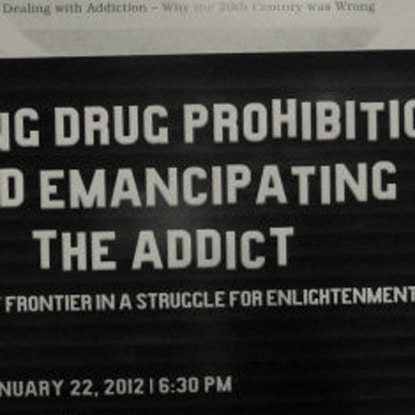
  • Talk – Ending Drug Prohibition and Emancipating the Addict: The Last Frontier in a Struggle for Enlightenment

    Talk – Ending Drug Prohibition and Emancipating the Addict: The Last Frontier in a Struggle for Enlightenment

    Time to wake up – Time to get busy – Time to step up – Make ‘em go tizzy

    Peter Ferentzy holds a Ph.D. in Social and Political Thought from York University. He’s an author and activist working hard to liberate people with addiction problems and turn over destructive drug policy paradigms. He says he knows this topic “from the gutter right up to the halls of academe”. As a historian of addiction he brings a long-term perspective. Ferentzy wrote his bookDealing with Addiction — Why the 20th Century was Wrong after he lost two friends to overdose. In both cases he says “the governing approach to addiction was the cause”.

    In his huffington post article titled “Ending Drug Prohibition and Emancipating the Addict”  Ferentzy argues that…

    emancipation of those with substance addictions is consistent with what our civilisation has been accomplishing over the last two hundred years. The overcoming of harsh attitudes toward drug addicts will be viewed in much the same light as, today, we view the abolition of harsh punishments for children, the introduction of woman’s suffrage or even the abolition of slavery.

    Catch Peter Ferentzy’s talk:

    Ending Drug Prohibition and Emancipating the Addict – the Last Frontier in a Struggle for Enlightenment

    With a special introduction by Dr. Gabor Mate. Brought to you by the PHS Community Services Public Lecture Series

  • Three drug policy stories to watch in 2012

    Three drug policy stories to watch in 2012

    Insite opens the door

    North America’s only sanctioned safe injection facility was the big news story of 2011. The September 30, 2011 Canadian supreme court decision in favor of the safe injection facility is a crucial victory for evidence-based science and policy over ideology. It is a historic decision for harm reduction advocates that has seemingly opened the door to similar services throughout Canada and possibly into the United States. It took the tenacity of the PHS Community Services Society to make it happen along with the Vancouver Area Network of Drug Users.

    The court ruling is explained on the PIVOT Legal Society’s blog “The historic Insite decision in a nutshell.” On May 17, 2011 the Director of the Canadian Drug Policy Coalition, Donald MacPherson, moderated a packed evening of discussion with legal professionals, medical experts, community activists and supervised injection site users. The evening focused on demystifying the legal battle and making the case for evidence-based drug policy.

    Check out the video here. Quebec seems like the next province set to open similar facilities.

    A recent report from the Montreal public health department has recommended opening three supervised injection sites and a mobile one in city neighbourhoods where intravenous drug use is rampant.We recently spoke with Cactus Montreal representative  Jean-Francois Mary about the impact of the ruling and future of supervised injection facillities in Montreal. You can watch the interview here.

    The Omnibus Crime Bill

    The Safe Streets and Communities Act passed in parliament with a majority vote of 157 to 127. It now sits in the senate. The conservative government has promised to push it into law by March 16, 2012, the 100th sitting day of the 41st Parliament.

    This Crime Bill moves Canada in the wrong direction. If passed, the bill will introduce mandatory minimum sentences for low-level drug crimes, further criminalizing individuals who use drugs and creating an enormous additional financial burden on society. This kind of sentencing practice has been a complete failure in the last 20 years in the United States as part of their “war on drugs.” It has deeply marginalized vulnerable citizens and done nothing to deter organized drug-related crime.

    Bill C-10 flies in the face of all of the evidence. The CDPC is not against legislation that attempts to address crime in our communities, but it must be based on a body of evidence that proves it can achieve its goals. Bill C-10 fails this test. Quebec’s justice minister has called the crime bill an inappropriate tough on democracy measure. Newfoundland’s Justice Minister has spoken out as well, saying the new crime bill will be completely unaffordable and has not been properly researched. Grand Chief Derik Nepinak of Manitoba’s Assembly of Chiefs, called a national press conference to say that the bill’s mandatory sentences would continue the legacy of residential schools, and must be opposed. Join us in 2012 as we work together withcoalition members and LeadNow and Avaaz to write next chapter.

    Canadian Medical Cannabis Regulation

    In April 2011 the Ontario Superior Court Justice Donald Taliano struck down the Marihuana Medical Access Regulations, ruling that ailing people are often unable to access medical marijuana through appropriate means and must find alternative illegal sources, risking arrest and criminal charges. He concluded that unless the government addresses the legislative flaws within three months, the criminal law would be struck down.

    The Conservative government is appealing the ruling. In June 2011 the Government of Canada announced it is considering improvements to the Marihuana Medical Access Regulations program to reduce the risk of abuse and exploitation by criminal elements.

    The proposed changes include:

    • Eliminating personal production licenses, ending legal personal home marijuana cultivation altogether
    • Eliminating patient identification cards, putting patients at risk of police action
    • Building a system of private for-profit marijuana growers and sellers who would provide to all patients in Canada,  severely limiting the range of quality strains of medicine
    • Continuing the unconstitutional “doctors as gatekeepers” system
    • Failing to address the many compassion clubs and medical marijuana dispensaries currently open across Canada

    “The government proposes to remove Health Canada as the ultimate arbiter in approving or rejecting applications to possess marijuana for medical use, and instead leave it up to doctors to decide whether their patients should be licensed to do so. While this might appear to be a liberalization, it is widely being rejected by doctors, who rightly assert that a responsibility that should pertain to Health Canada is being off-loaded on them without appropriate research having been conducted on the medicinal properties of marijuana.”

    Many members of the CDPC are calling for alternative approaches to medical and broader cannabis related policies. The Canadian Association of Medical Cannabis Dispensaries is a coalition partner working towards a regulated community-based approach to medical cannabis access and supporting medical cannabis dispensaries to provide the highest quality of patient care. Check out their campaign.

    Stop the Violence BC  is a coalition of academics, past/present members of law enforcement, and the general public concerned about the links between cannabis prohibition in BC and the growth of organized crime and related violence in the province. Calling for a regulated approach Stop the Violence makes a strong case for policy reform in BC and provides a solid foundation of public support and evidence for implementing change.

    Also in 2012-Keep an eye out for the first CDPC policy paper out soon!

    Right now, get involved in spreading the Health Officers Council of BC (HOC) recently released discussion paper, Public Health Perspectives for Regulating Psychoactive Substances – What we can do about alcohol, tobacco and other drugs.
    Together with the HOC we hope to stimulate public and governmental discussions, development of policy proposals, and action on public health oriented regulation of psychoactive substances. Subsequent to receipt of letters of support and feedback over the next few months the HOC will be submitting this paper, with necessary addenda or changes, to governments for their response and action. Send us your message of support, sign up to the coalition, and write to the HOC directly.

    Dr. Paul Hasselback, Chair
    3rd Floor, 6475 Metral Drive
    Nanaimo, BC V9T 2L9
    Fax: 250-755-3372