Tag: safe supply OAT and iOAT

  • Canadian Drug Policy Coalition releases findings of first-of-its-kind qualitative research on safe supply of drugs 

    Canadian Drug Policy Coalition releases findings of first-of-its-kind qualitative research on safe supply of drugs 

    Unceded territories of the xʷməθkʷəy̓əm (Musqueam), Sḵwx̱wú7mesh (Squamish) and səlilwətaɬ (Tsleil-Waututh) First Nations (Vancouver, B.C., Canada) – Today, the Canadian Drug Policy Coalition (CDPC) released the findings from its three-year Imagine Safe Supply study that examined ideas about safe supply participation with people who use drugs and frontline workers.

    “The debate around a safer supply of drugs is making headlines across Canada, for all the wrong reasons,” said DJ Larkin, Executive Director of the CDPC. “Misinformation and stigma are turning attention away from evidence, data and meaningful engagement with people most affected by our current toxic drug crisis. These misinformed narratives have the potential to do very real harm, and worsen an already unbearable situation that is causing the deaths of thousands of people every year. This research refocuses on what’s possible when we work toward solutions that are effective and meaningful for people who use drugs.”

    “In our research, we looked into the gaps between current access to regulated supply of drugs and ‘desired’ safe supply,” said Erin Howley, Senior Research Associate with the CDPC, and the Imagine Safe Supply project lead. “This data offers deep insight into what effective safe supply based on the leadership of people who use drugs could look like.”

    The three-year, community-based qualitative research project involved in-depth interviews with 33 people from across British Columbia, Alberta, Ontario, and Quebec about what they need for safe supply. Key findings from Imagine Safe Supply include:

    • The values of community-building, autonomy and self-determination, mutual care, trusted relationships, and cultural inclusion are central to the design of any effective safe supply program or service.
    • Effective safe supply includes a range of choices around drug options and dosages that reflect people’s unique reasons, needs and desires for using drugs. 
    • Holistic safe supply would offer a spectrum of models and supports to address the diverse needs and person-centered goals of PWUD; there is no one-size fits all approach. Effective safe supply supports a full range of choices including consensual and equitable detox and treatment options, and holistic social and economic supports, including housing.
    • All levels of government and decision-makers need to prioritize approaches to safe supply that centre the knowledge, leadership, and relationships between people who use drugs.

    The Imagine Safe Supply research team includes people who use drugs and frontline workers, as well as graduate students and staff of the Canadian Drug Policy Coalition at Simon Fraser University. The research team co-created and led every stage of the project, including research design, interviews, data analysis, and knowledge sharing. This research was undertaken through a partnership with Thunderbird Partnership Foundation, which stewards all data related to First Nations research participation in accordance with OCAP® Principles; First Nations findings have not yet been published. 

    “Our project has the word ‘imagine’ in its title for a reason,” said Phoenix Beck McGreevy, Community Research Associate. “We asked people to envision their ideal safe supply program, from the available substances to the staff and the setting. When people ventured outside the realm of what’s currently possible, that was where the really beautiful data lived.” 

    “This research changes the channel on the safe supply debate, by placing people who use drugs and frontline workers front and centre,” said Howley. “These findings offer resources that bring real-world experience to the drug policy debate, and provide knowledge and guidance to service providers, clinicians and decision-makers developing effective responses to the drug poisoning crisis in Canada.”

    The CDPC is calling on decision-makers in Canada to increase the scale and scope of safe supply access across Canada, including rural and remote areas and to underserved populations. This includes ensuring access to regulated drugs of known contents and potency to act as an alternative to the toxic unregulated drug supply, and ensuring people using drugs – with an emphasis on racialized and Indigenous people who are disproportionately affected by this crisis – are fully involved in safe supply design and delivery.  

    -30-

    Images available for download

    See dropbox link for:

    • Photographs of the Imagine Safe Supply research team
    • Illustrated headshots of the Imagine Safe Supply research team
    • Illustrations from the Imagine Safe Supply Zine, a forthcoming knowledge translation document created to share findings from the research

    Background:

    The Canadian Association of People Who Use Drugs (CAPUD) defines safe supply as “a legal and regulated supply of drugs with mind/body altering properties that traditionally have been accessible only through the illicit drug market”. Safe supply means drugs that are legally regulated with a known potency and composition. More information on Imagine Safe Supply and its findings can be found at https://drugpolicy.ca/imagine-safe-supply/

    About the Canadian Drug Policy Coalition

    Founded in 2010, the Canadian Drug Policy Coalition works in partnership with more than 60 organizations and 7,000 individuals working to support the development of a drug policy for Canada that is based in science, guided by public health principles, respectful of the human rights of all, and seeks to include people who use drugs and those harmed by the war on drugs in moving towards a healthier society. Learn more at www.drugpolicy.ca

    Media contact:

    Lesli Boldt for Canadian Drug Policy Coalition

    [email protected]

    604-662-3500

    Vancouver, B.C.

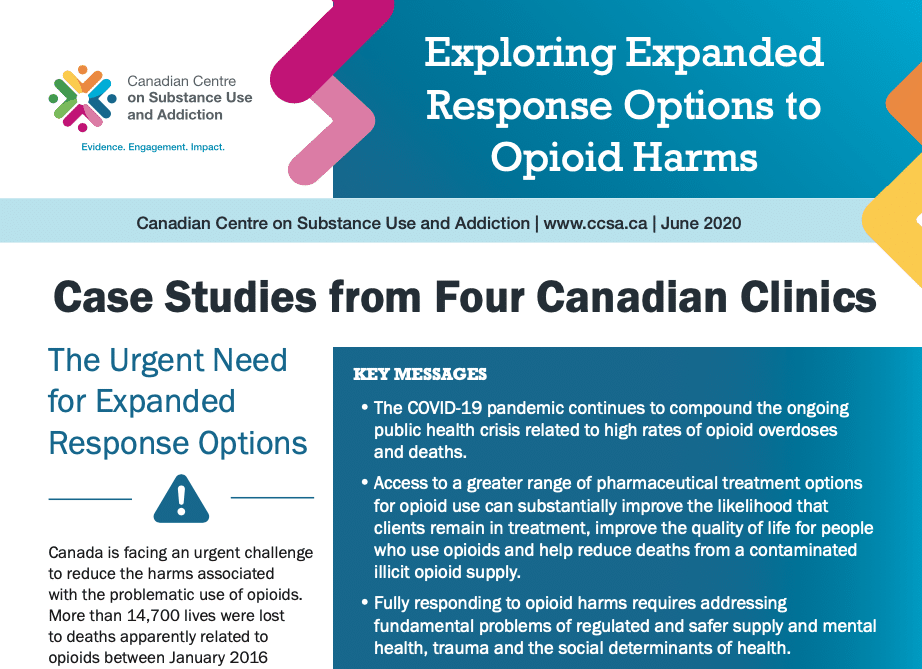
  • Expanded Response Options to Opioid Harms: Case Study from Four Cities

    Expanded Response Options to Opioid Harms: Case Study from Four Cities

    CCSA case study, CCSA case study

    Click HERE for more resources

    “Canada is facing an urgent challenge to reduce the harms associated
    with the problematic use of opioids. More than 14,700 lives were lost to deaths apparently related to opioids between January 2016 and September 2019. During that same period, there were 19,490 hospitalizations for poisoning related opioid to opioids (Special Advisory Committee on the Epidemic of Opioid Overdoses, 2019). The COVID-19 pandemic compounds this ongoing public health crisis. There is a heightened need to reduce avoidable pressures on healthcare systems and support people who use opioids who may be at increased risk or unable to self-isolate during the pandemic.”

    Source: Canadian Centre on Substance Use

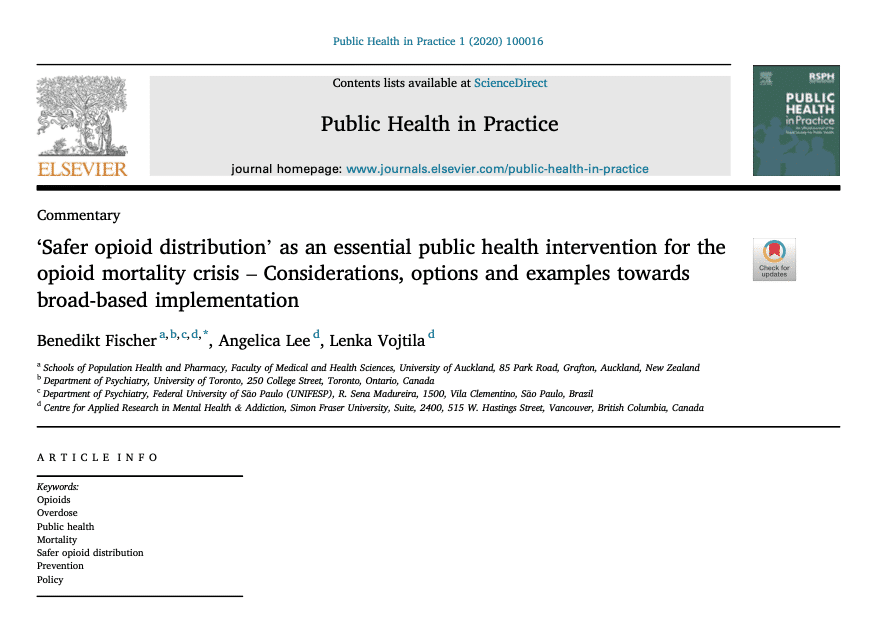
  • ‘Safer opioid distribution’ as an essential public health intervention for opioid mortality crisis

    ‘Safer opioid distribution’ as an essential public health intervention for opioid mortality crisis

    safer opioid distribution as public health intervention safer opioid distribution as public health intervention

    Click HERE for more resources

    Highlights:

    • Canada experiences excessive opioid mortality, mainly from toxic opioid exposure.
    • Many interventions have been implemented, but are limited in reach and impact.
    • ‘Safer opioid distribution’ (SOD) is a crucial preventive measure for overdose.
    • SOD needs to be implemented for a large, ‘at-risk’ opioid user population.
    • Other community-based public health interventions may guide SOD organization.

    Source: https://www.sciencedirect.com/science/article/pii/S266653522030015X?via%3Dihub

  • Expanding access to diacetylmorphine & hydromorphone in Canada

    Expanding access to diacetylmorphine & hydromorphone in Canada


    Click HERE for more resources

    Abstract: The increasing incidence of fatal opioid overdose is a public health crisis in Canada. While buprenorphine/naloxone and methadone are the standard first-line of opioid substitution options, limitations, including difficulty achieving long-term retention for some people who use opioids, are well known. For this group, injectable diacetylmorphine or hydromorphone can achieve positive outcomes, including high retention rates, reduced use of unregulated opioids, and reduced criminal activity.

    In May 2019, Health Canada announced changes to increase the accessibility of diacetylmorphine and hydromorphone, and in September 2019, the CIHR-funded Canadian Research Initiative in Substance Misuse released a national clinical guideline for diacetylmorphine and hydromorphone as additional frontline substitution options.

    While these developments present opportunities for scale-up, significant financial, structural, and practice barriers continue to impede access. This commentary explores the current state of policy and practice for diacetylmorphine and hydromorphone as opioid substitution options in Canada, outlines the rationale for rapid expansion of access, and highlights clinical and policy changes that must be undertaken or the death toll will continue to rise.

  • COVID-19: Information for OAT Prescribers and Pharmacists

    COVID-19: Information for OAT Prescribers and Pharmacists


    Click HERE for more resources

    On March 11, 2020, the World Health Organization declared the novel coronavirus, COVID-19, a pandemic, citing concern over alarming levels of spread and severity across the globe. The novel coronavirus has caused a global outbreak of respiratory infections since its discovery in December 2019. For most, this coronavirus causes only mild to moderate symptoms including fever and cough, however, older adults and those with existing health problems are at greater risk for more severe symptoms such as pneumonia.

    The situation regarding COVID-19 continues to evolve here in BC, Canada, and other jurisdictions in the world. Federal and provincial health officials have urged individuals on chronic medications to acquire an adequate supply of prescription drugs. Ensuring uninterrupted access to essential medications, including opioid agonist treatment (OAT) medications for patients with opioid use disorder, is of critical importance to reduce the risk of harms and death that can be associated with medication destabilization.

  • Prescriber Guidelines Risk Mitigation in Dual Public Health Emergencies

    Prescriber Guidelines Risk Mitigation in Dual Public Health Emergencies

    Click HERE for more resources

    People in the Downtown Eastside (DTES) are doing their part to reduce the transmission of COVID-19 by self-isolating; we need to do our part in supporting them. VCH has new guidelines in place to help prescribers support people who use drugs (PWUD) who need assistance managing withdrawal symptoms due to COVID-19.

  • FAQ: Class Exemption for  Controlled Substances during COVID-19

    FAQ: Class Exemption for Controlled Substances during COVID-19


    Click HERE for more resources

    Click HERE for French version

    The World Health Organization’s declaration on March 11, 2020, that the novel coronavirus (COVID-19) is now a pandemic and has marked a significant shift in the response from communities across Canada and at all levels of government.

    In response to this evolving health risk, the Office of Controlled Substances has issued a short-term subsection 56(1) exemption from the Controlled Drugs and Substances Act in the public interest. This exemption authorizes pharmacists to prescribe, sell, or provide controlled substances in limited circumstances, or transfer prescriptions for controlled substances.

  • CDSA Exemption and Interpretive Guide for Controlled Substances

    CDSA Exemption and Interpretive Guide for Controlled Substances


    To maintain Canadians’ access to controlled substances for medical treatments (e.g., treatment of substance use disorders and chronic pain), while they adhere to social distancing guidance from public health officials or if they need to self-isolate, Health Canada has issued the attached exemptions for prescriptions of controlled substances under the Controlled Drugs and Substances Act (CDSA) and its Regulations.

    If permitted within the applicable provincial/territorial scopes of practice, the exemptions:

    • permit pharmacists to extend prescriptions;
    • permit pharmacists to transfer prescriptions to other pharmacists;
    • permit prescribers to issue verbal orders (i.e., over the phone) to extend or refill a prescription; and
    • permit pharmacy employees to deliver prescriptions of controlled substances to patient’s homes or other locations where they may be (i.e self isolating).

    “We strongly encourage all partners to work to implement these exemptions in their jurisdictions and welcome any additional suggestions you may have to maintain Canadians’ access to controlled substances for medical reasons during the pandemic.”

    ~ Health Canada

  • COVID-19 Guidance for Clinicians & Opioid Treatment Programs

    COVID-19 Guidance for Clinicians & Opioid Treatment Programs

    Click HERE for more resources

    Guidance from the Yale Program in Addiction Medicine