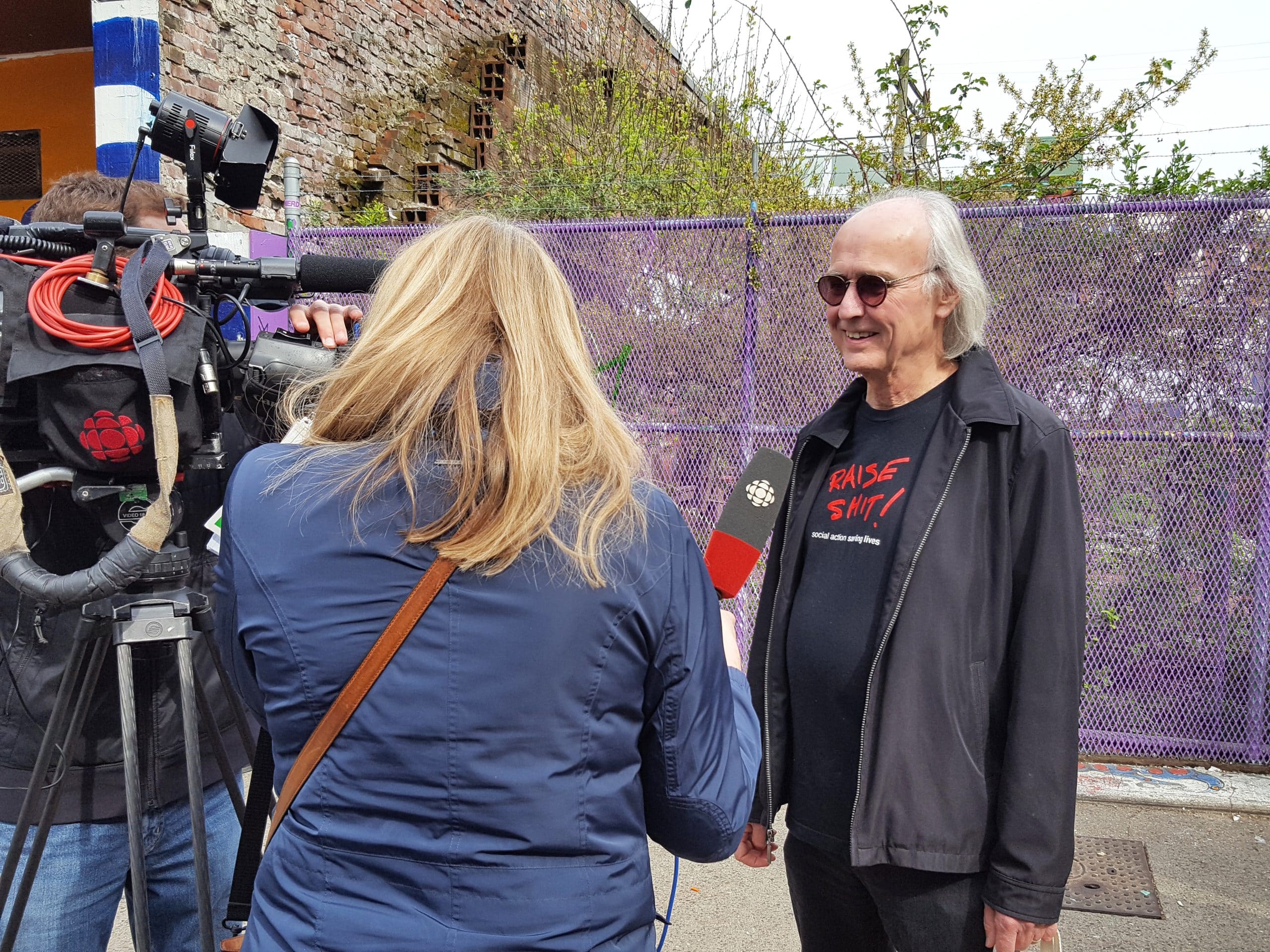
CDPC’s Executive Director, Donald MacPherson, is retiring. On behalf of the CDPC Steering Committee, I want to recognize his incredible contributions to drug policy and the CDPC, and thank him for his unwavering mission to make drug policy humane, equitable, realistic and just.
Before bringing his passion and insight to the creation of CDPC, Donald worked with the City of Vancouver as the Director of the Carnegie Centre, and then as the city’s Drug Policy Coordinator. In that latter role, he published Vancouver’s ground-breaking Four Pillars Drug Strategy in 2000. This framework reflected the then-still-controversial notion that health care for people who use drugs must be understood broadly, beyond just abstinence from drug use, positioning harm reduction as a necessary element of any sensible, effective strategy.
Donald co-founded the Canadian Drug Policy Coalition in 2011 to bring people together from across the country in a coordinated, ongoing effort to challenge and reform drug policy as a matter of not only local but national concern. As the drug poisoning crisis exploded, Donald positioned CDPC as a leader in advocacy. For years, he has convened people who use substances, politicians, health and legal experts, and other stakeholders to focus upon specific issues such as supervised consumption spaces and safe supply, decriminalization/legalization/regulation and many other critical interventions. Through changing governments at municipal, provincial and national levels, Donald has created strategies to work well with those who consider drug policy reform a valid pursuit, as well as those who are opposed because of fear, misunderstanding or ideology.
Donald has been deeply committed to the meaningful and active involvement of people who use substances and has heightened the voices of people affected the most by unjust drug policies. Similarly, he has sought to ensure that CDPC’s work confronts the truths of the racism embedded in punitive drug policies and contributes to ongoing efforts at reconciliation with the First Peoples of Canada.
In addition to his many accomplishments in community, Donald is also co-author of Raise Shit! Social action saving lives (2009) and More Harm than Good: Drug policy in Canada (2016), regularly contributes to various reports and scholarly papers, and has shared his knowledge and experience around the world, including as vice-chair of the Board of the International Drug Policy Consortium, a civil society organization working to improve policy responses to drugs globally.
Donald served on Health Canada’s Expert Task Force on Substance Use, which issued unambiguous recommendations to end criminalization of simple possession and other measures to support and protect people who use drugs and communities – measures we’re finally seeing some progress on. He is an adjunct professor at Simon Fraser University, and has also been awarded an Honorary Doctorate from Adler University in Chicago/Vancouver, the Queen Elizabeth II Diamond Jubilee Medal, and Nora and Ted Sterling Prize in Support of Controversy at Simon Fraser University for his contribution to social justice in the field of drug policy.
Donald has been a mentor, teacher and example of commitment to many people from all walks of life. He has affected people’s views and persuaded the unpersuadable. He has been a giant on the national and international stage. But he has also been humble, kind, quiet, patient, respectful, approachable, and creative. He will speak of drug policy as effectively in a city of several million as in a small remote community. He is diplomatic when needed and forthright when necessary.
Donald has been a force for change in this country, advancing equity, justice and human rights. In recent months, as word that Donald would transition into a well-deserved retirement, one of the phrases I have heard most often is “How can we fill Donald’s shoes?”. It will be difficult. But Donald will leave us with an army of informed, committed, energetic people who understand the issues of drugs and drug policy, and who are enthusiastic to push forward with advocacy to make the world better.
Thank you, Donald! You will be missed greatly! Have a very happy retirement!
Following a nationwide search, the Canadian Drug Policy Coalition (CDPC) is pleased to announce that DJ Larkin has been chosen as the organization’s new Executive Director. DJ will succeed Donald MacPherson, the founding Executive Director of CDPC, who is retiring later this year after over a decade with the Coalition.
DJ currently lives on the unceded Indigenous lands of the xʷməθkʷəy̓əm (Musqueam), Skwxwú7mesh (Squamish) & səlil̓wətaʔɬ (Tsleil-Waututh) Peoples, and is committed to lifelong learning, self-improvement, and action to dismantle settler colonialism.
DJ Larkin is a respected lawyer and legal advocate who has worked on issues impacting people experiencing criminalization and systemic marginalization for over a decade. DJ has worked to centre the voices of people who use drugs through support for peer-led groups in Vancouver’s Downtown Eastside and in working with individuals and organizations in numerous other regions and communities. DJ has represented Indigenous governments—both elected and hereditary—in litigation regarding rights, land, and resource management. In 2017-2018, DJ also co-investigated and co-authored an in-depth report on systemic exclusion and marginalization of people living at the intersection of poverty, housing insecurity, and criminalized substance use aimed at creating systemic legislative and policy reform.
The CDPC vision is clear and its mission unwavering,” DJ said of the Coalition. “This reflects the work of generations of brilliant and dedicated people who use drugs, activists, academics, allies, advocates, and policy leaders like Donald MacPherson. I also know that so much more work needs to be done, and I have enormous shoes to fill. I’m honoured to have the opportunity, and I look forward to getting to work later this spring.”
DJ Larkin will join the CDPC as executive director in April 2023.
Contact us: Alessia Matsos Communications Coordinator Canadian Drug Policy Coalition [email protected] (905)-869-7451
June 1, 2022 – A growing group of drug policy and human rights organizations across Canada — comprising people who use drugs, health professionals, legal experts, academics, and others — say the Government of Canada’s latest move to decriminalize drug possession should go further to protect everyone, in particular those most endangered by drug prohibition and the drug toxicity crisis. We support policy that moves the needle forward; however, it is disappointing that decriminalization under the model announced on May 31st will not protect all people who use drugs from the harms of criminalization.
We support progress, but we dream bigger. We want full decriminalization for all.
Yesterday, the Government of Canada, led by its newly created Ministry of Mental Health and Addictions, joined with the Government of British Columbia to announce implementation of B.C.’s requested exemption to the Controlled Drugs and Substances Act (CDSA). B.C. is the first jurisdiction in Canada to effect this policy change. The policy provides legal protection to adults in B.C. who possess illicit drugs up to a cumulative total of 2.5 grams.
Yesterday’s announcement validates the efforts of people who use drugs and their allies across B.C. and Canada, who have for decades led the charge for drug decriminalization. But the announcement also signals a missed opportunity. A cumulative threshold quantity of 2.5 grams leaves many people who use drugs behind, namely those living in rural and remote communities who already bear the disproportionate brunt of drug prohibition and the drug toxicity crisis. People purchase larger quantities of drugs for myriad reasons: geographic restrictions, personal mobility reasons, and to limit interactions with the illicit drug market. Concerns over too-low threshold quantities were expressed repeatedly to B.C. and Health Canada by B.C.’s own Core Planning Table for Decriminalization and the Board of the Vancouver Network of Drug Users (VANDU) — to no avail.
This decision comes just as a more progressive drug policy bill, Bill C-216, is up for vote in Parliament today, on June 1. It is clear that the timing of the announcement is meant to hamper the progression of that bill through to committee stage, whereupon it could be further strengthened. Nonetheless, we call on Members of Parliament to listen to the voices of experts in this field and vote Bill C-216 through to committee stage today.
The fact that Canada is not considering national action towards decriminalization is shameful at this juncture, particularly as three jurisdictions have already applied for exemptions to date. The piecemeal approach the Government of Canada is now clearly taking does not adequately address the urgency of the drug poisoning crisis in this country.
We will continue to push for decriminalization for everyone and to turn the page on an outdated drug war that continues to kill as many as 20 people each day in Canada. Criminalization has failed, and there is no need to continue along this misguided path. Truly, a systems change is required in the context of a public health emergency caused by the system itself. We must decriminalize drugs and the people who use them, and provide access to a legal, regulated supply. Canada cannot wait.
Toronto, ON—In the wake of almost 23,000 drug poisoning deaths since 2016, twenty-one civil society organizations across the country, including groups of people who use drugs, families affected by drug use, drug policy and human rights organizations, frontline service providers, and researchers, have collaborated to release Canada’s first civil society-led policy framework for drug decriminalization in Canada.
“The Canadian Association of People Who Use Drugs welcomes this timely national call to action on drug decriminalization. This rights-based path for drug policy reflects the input of many people who use drugs and presents a decriminalization model that serves as an important starting point for policymakers to decriminalize and regulate presently illegal drugs,” said Natasha Touesnard, Executive Director of the Canadian Association of People Who Use Drugs.
“Only with comprehensive drug decriminalization, allowing the provision of an effective and accessible safe supply of presently illegal drugs, will the devastating ongoing overdose epidemic stop.”
~ Natasha Touesnard, Canadian Association of People Who Use Drugs
This comprehensive platform, endorsed by more than 100 organizations calls for the following:
— Full decriminalizationof all drug possession for personal use—as well as sharing or selling of drugs for subsistence, to support personal drug use costs, or to provide a safe supply—by doing the following:
Repeal section 4 of the Controlled Drugs and Substances Act (CDSA) and section 8 of the Cannabis Act
Amend section 5 of the CDSA, which criminalizes trafficking-related offences
Remove all sanctions and interventions linked to simple drug possession or necessity trafficking
Automatically expunge past convictions for simple drug possession and past convictions for breaches of police undertakings, bail, probation, or parole conditions associated with charges for these acts
Set strict rules around when police can stop, search, and investigate a person for drug possession
Remove police and law enforcement as “gatekeepers” between people who use drugs and health and social services, and replace them with organizations led by people who use(d) drugs or trained frontline workers
— Redistribution of resourcesfrom enforcement and policing to non-coercive, voluntary policies, programs, and services that protect and promote people’s health and human rights, including health, education, housing, and social services that support people who use drugs.
“The war on drugs has been a colossal failure. Under a regime of criminalization, people who use drugs are vilified, subject to routine human rights abuses, and denied access to life-saving healthcare, leading to preventable infection and death,” said Sandra Ka Hon Chu, Co-Executive Director of the HIV Legal Network. “To undo those harms, decriminalization must be done right. Reflecting community voices, including those most directly affected by drug prohibition, this platform presents a vision for governments to remove the stifling threat of criminalization from the lives of people who use drugs.”
Ready to help?
Support drug policies rooted in social justice, compassion, and evidence. Sign up for our newsletter to get updates and learn how you can take action with us.
More than a century of drug prohibition aimed at deterring drug use has failed, and there is no greater evidence of this failure than the thousands of deaths due to drug poisonings across Canada and an overdose crisis that continues unabated. Prohibition is rooted in, and has reinforced, racism, sexism, and colonialism and has disproportionately affected Black and Indigenous people who are at much higher risk of arrest and severe punishment for drug offences.
“Cops have been enforcing the drug war for over a century. Carding, harassing, arresting, beating and incarcerating drug users—especially if we’re Black or Indigenous. It’s high time cops stand down and get out of our lives. They have caused so much harm,” said Garth Mullins, member of the Vancouver Area Network of Drug Users.
“No more cops, courts and jails for drug users. No more para-military police occupation of marginalized communities. That’s what real decriminalization means.”
~ Garth Mullins, Vancouver Area Network of Drug Users
The harms of criminalization follow people for the rest of their lives: criminal records limit employment and housing opportunities, affect child custody, and restrict travel, among other repercussions. Additionally, enforcing drug offences consumes billions of dollars annually.[1] “We continue to resource policing and punishment while defunding services in our communities that actually address the roots of harm and violence. Our prisons are full of people who need help, not a record,” said educator and activist El Jones.
“The stigma of drug use ruins lives. It is long past time to stop funding a war on drugs, and to invest in real public safety: housing, mental health, childcare, and living in a society free of oppression for all people, including those who use drugs.”
“The sharing of different experiences and expertise across this country has resulted in a common vision of what drug policy should be in Canada. By opting for this civil society platform, the federal government has the power to reduce the harms associated with the criminalization of people who use drugs. We all have the right to respect, safety, access to healthcare and social services—and to a better life, free from judgment and discrimination.” (Sandhia Vadlamudy; Executive Director, Association des intervenants en dépendance du Québec (AIDQ))
“The war on drugs has not only fed policing and prisons in this country, it has had devastating effects on our families. Black and Indigenous mothers in particular have seen their children taken into the child welfare system, causing generational trauma. Schools, hospitals, and even our homes have become sites of violent policing which has done nothing to address trauma, to heal, or to help people who want treatment for addictions. (El Jones; Educator, Journalist, Activist)
“Decriminalization Done Right proposes a policy shift that is long overdue and is a first step to change a historically cruel and misguided application of the criminal law that has devastated the lives of countless Canadians. If adopted by Canada, it would be an important step towards a compassionate, human rights-based approach based on evidence that builds stronger communities for everyone.”(Donald MacPherson; Executive Director, Canadian Drug Policy Coalition)
“Punishing people who use drugs is unfounded drug policy and creates stigma that is much more detrimental than drugs themselves.” (Jean-Sebastien Fallu; Professor, University of Montreal)
“Led by respected and internationally recognized national organizations, this platform on drug decriminalization is now the centerpiece of actions that our governments must take. The principles it defends and the values it advocates represent civil society’s contributions to essential reforms that are faithful to human rights and social inclusion.” (Louis Letellier de St-Just; lawyer (health law), Board Chair and Co-Founder CACTUS Montréal)
“Punitive drug policies rooted in racism and colonialism have failed and caused catastrophic harm. Youth are particularly stigmatized and targeted because they are young. As decriminalization now seems closer to reality than ever before, it’s crucial that we ensure voices of young people who use drugs are central to these discussions.” (Kira London-Nadeau; Chair, Canadian Students for Sensible Drug Policy)
“Neither sick nor guilty—people who use drugs are not criminals, and the legislation must reflect this reality.” (Chantal Montmorency; Executive Director, Association québécoise pour la promotion de la santé des personnes utilisatrices de drogues)
Contributors
Association des intervenants en dépendance du Québec (AIDQ)
Association québécoise pour la promotion de la santé des personnes utilisatrices de drogues (AQPSUD)
Vancouver, B.C.—A broad-based Canada-wide coalition of human rights, drug policy, community, and drug user organizations are raising serious concerns about a proposed model for drug decriminalization that will be submitted to the federal government for approval. If adopted, the flawed “Vancouver Model,” as proposed by the City of Vancouver, could be a precedent-setting policy change—the first of its kind in Canada—that could pave the way for other cities to follow suit, including communities in Ontario, Alberta, and Quebec among others. It is therefore critical that this initial model gets decriminalization right by centering the health and rights of people who use drugs, as well as the needs of their loved ones and communities.
“The mayor personally guaranteed to involve people who use drugs all the way along. But instead, the city met with police behind closed doors and cooked up a restrictive regime. They locked us out and never told us the details until it was a fait accompli,” says Garth Mullins, with the Vancouver Area Network of Drug Users.
“If I was still using as much heroin as I used to, the mayor’s ‘Vancouver Model’ would re-criminalize me, not set me free. But it’s not too late to fix this.”
~Garth Mullins, Member, Vancouver Area Network of Drug Users
Ready to help?
Support drug policies rooted in social justice, compassion, and evidence. Sign up for our newsletter to get updates and learn how you can take action with us.
Committed to the health and human rights of people who use drugs and progressive, evidence-based drug policy reforms, the coalition is calling on the federal government to address three critical flaws inherent to the current Vancouver Model. These flaws are outlined in a public statement, Decriminalization Done Right: A Human Rights and Public Health Vision for Drug Policy Reform, released today, and are:
1.Lack of meaningful engagement of people who use drugs in designing a system that was meant for them. People who use drugs have not been meaningfully consulted, and this has resulted in a proposal that does not reflect the current realities of drug use. This will ultimately diminish the success of the proposed plan to decriminalize personal possession of drugs in Vancouver. A system co-developed by those at the centre of the issue is far more likely to succeed. The coalition is calling on the Government of Canada and City of Vancouver to engage people who use drugs in a substantive and meaningful way.
2. Drug threshold amounts for decriminalized possession are too low. Health Canada has asked the City of Vancouver to propose threshold amounts for each drug that a person may legally possess. Threshold quantities—depending on how they are set—can provide clarity and advance the health and human rights of people who use drugs. However, if set too low, these thresholds can render a proposal for decriminalization largely meaningless and lead to harm. The thresholds proposed by Vancouver are far too low, failing to reflect the realities of current patterns of drug use. Based on three studies, which Vancouver admits are dated, the proposed thresholds overlook that many people’s drug tolerance and purchasing patterns have dramatically increased and that the drug market itself has changed because of COVID-19. Consultations with people who use drugs only occurred after thresholds were submitted to Health Canada. The coalition is calling on Health Canada and or the City of Vancouver to amend the proposed thresholds to more realistic levels after meaningful consultation with people who use drugs. “The inclusion and impact of unrealistic thresholds will partially negate the intent of a decriminalization law, and will keep people in the shadows,” says Leslie McBain, co-founder of Moms Stop the Harm.
“The criminalization of people who use drugs and the stigma that comes with it has long-lasting negative consequences for individuals, including fear within their families and friends. Criminalization causes instability and fear for people who use drugs who often, as a consequence, use illicit drugs alone and die alone.”
~Leslie McBain, Co-founder, Moms Stop the Harm
3. Police are dictating the parameters of decriminalization. From the beginning, the Vancouver Police Department (VPD) has been involved in the design of this proposal. This is extremely concerning because “de”-criminalization is meant to remove police involvement from a policy intervention, not give them a greater role by allowing them considerable input in its design. As the City of Vancouver has stated, the current model is meant to be a public-health focused, evidence-based policy. Given the extent to which police actions have historically worked at cross-purposes with health and harm reduction efforts, we have significant concerns about the extensive role of the VPD in this process. There is no legal or other basis requiring police to have the input. We call on the City of Vancouver to remove police influence from the process and the form of decriminalization being proposed to Health Canada.
“We call for an approach to drugs based on best practices, including the full participation of people affected by drug criminalization. Several municipalities in Quebec have taken steps in this direction and some have urged the federal government to decriminalize simple possession and put an end to the harmful reprisals experienced by drug users and their families,” says Sandhia Vadlamudy, Executive Director of L’Association des intervenants en dépendance du Québec.
“Quebec municipalities, including Montreal, must avoid the trap present in the model developed by Vancouver. AIDQ supports efforts to ensure that Quebec adopts an inclusive and non-stigmatizing posture with people who use drugs. We must support and not punish.”
~Sandhia Vadlamudy, Executive Director, L’Association des intervenants en dépendance du Québec
Furthermore, the proposed model does not adequately address the intergenerational harm caused by the over-policing and structural stigma directed at Indigenous and Black communities and people of colour who disproportionately feel the impacts of prohibition. Any proposal—if it is to succeed—must address this reality. #DecrimDoneRight should be based on evidence and good public policy, not police objectives.
Finally, the proposed model does not meet the needs of young people, and explicitly excludes youth under age 19 from the benefits of decriminalization. Instead, the model affirms the discretionary power of police, continuing a worrying trend of maintaining police as the primary resource available to youth, who are stigmatized and targeted for their drug use specifically because of their age.
“There’s no good reason to continue criminalizing people for simple drug possession in Canada, but there is plenty of evidence that our current laws cause significant harm. To realize the benefits of decriminalization, the federal Minister of Health must insist that the thresholds reflect real-world use and the input of people who use drugs.”
~Sandra Ka Hon Chu, Director of Research and Advocacy, HIV Legal Network
Contacts
Dr. Thomas Kerr — Senior scientist at BC Centre on Substance Use and professor in the Department of Medicine at University of British Columbia: 604-314-7817 (can speak to threshold amounts)
Garth Mullins — Vancouver Area Network of Drug Users, Crackdown Podcast: [email protected]
Jean-Sébastien Fallu —Université de Montréal (French/English): [email protected], 514-777-5948
Download our primer, which outlines why and how provincial and municipal governments should request such an exemption.
Additional Quotes
“People who use drugs need support, acceptance, and inclusion. We have to move forward and stop structurally stigmatizing them by our drug laws and policies. They are neither criminals nor sick” (Jean-Sébastien Fallu, Université de Montréal)
“Nurses in British Columbia have been calling for decriminalization for two years. Vancouver had the opportunity to develop a model in partnership with people most impacted by decriminalization and using best practices of consultation, engagement, and transparency. It failed to do so. The proposed model will continue to punish and harm people who use drugs, and maintain barriers to health care. It does not align with a health care approach.” (Marilou Gagnon, Harm Reduction Nurses Association)
“Youth must be involved meaningfully and equitably in the co-development of policies that are going to impact them, which has not happened with the development of the ‘Vancouver Model.’ The institutions currently involved do not speak on behalf of youth and the proposal does not reflect the realities of young people and drug use. Any model that does not include youth is not truly decriminalization.” (Canadian Students for Sensible Drug Policy, Vancouver Chapter)
Edmonton, AB—Canadian Association of People Who Use Drugs, Canadian Drug Policy Coalition, Friends of Medicare, Moms Stop the Harm, and HIV Legal Network are deeply concerned about the health and safety impacts to vulnerable individuals accessing life-saving injectable opioid agonist treatment (iOAT) in Alberta.
Yesterday, a court ruling upheld a decision by the Government of Alberta to end iOAT at clinics in Calgary and Edmonton by dismissing an injunction application to keep these vital, life-saving services running at those clinics. In our view, the ruling does not take into account the lived experience and perspectives of people who use drugs who attested to the benefits of the program and how ending it would threaten their health and safety. Earlier, the court heard that individuals suffering from severe opioid use disorder could face “irreparable harms including risk of death” if the government-funded treatment program is halted in March as planned. This included evidence that the Government’s decision to close the clinics has already contributed to severe harm to patients.
The current iOAT program, prior to the Province creating uncertainty with its decisions, had a reported retention rate of over 80%, which is much above typical rates for substance use treatment. The Province of Alberta has in the past stated that addiction treatment should include services that support people beyond their substance use, something this program has done. It offers wrap around care, including on-site social workers who connect people with housing, income and employment support, psychologists and psychiatrists who help people deal with their underlying issues, including trauma, and most importantly peers with lived experience who understand and relate to the challenges the iOAT patients are going through. All this has contributed to the success of the iOAT program and has saved lives. This wrap around support will not be available in the unspecified model proposed by the Province.
Ready to help?
Support drug policies rooted in social justice, compassion, and evidence. Sign up for our newsletter to get updates and learn how you can take action with us.
The recent ruling could result in individuals relying, once again, on a toxic supply of drugs from an unregulated, dangerous market outside a medical/community context and thus being exposed to the potential for further irreparable harm. It relied on an incomplete understanding of opioid use disorder and a lack of literacy around substance use, addiction, and the lives of people who use drugs. Once again, the voices and perspectives of people who use drugs—who are experts in their own experience—were not given sufficient weight in a decision directly impacting their health and wellbeing.
Justice Dunlop, in his ruling, is quoted stating, “a causal connection between the Province’s planned changes and iOAT patients returning to street opioid use has not been proved.” But harms have already surfaced due to the Alberta government’s transition planning over the last year. The evidence before the court demonstrated that the Government’s decision has already contributed to one death and other serious harm for patients. Patients anticipate experiencing further serious, and irreversible harm once the clinics are shuttered.
This ruling is especially concerning given the climate we now see ourselves in: two concurrent public health crises and a rise in overdose deaths across Canada due to COVID-19. It is precisely in times such as these that health services like iOAT should be expanded rather than scaled back. The decision to end these services in March is unconscionable and will risk the wellbeing of the plaintiffs in this trial. As individuals affected by the drug poisoning crisis, concerned citizens, health service providers, and professionals in the field, we are deeply troubled by the adverse health impacts that could follow from this decision. Lives are at stake.
Contacts
Natasha Touesnard, Executive Director Canadian Association of People Who Use Drug [email protected] | 902-223-9151
Kym Porter, Alberta advocacy leader Moms Stop the Harm [email protected] | 403-580-7051
Petra Schulz, Co-FounderMoms Stop The Harm [email protected] | 780-708-2244
Alyssa Pretty, Communications and Administrative Officer Friends of Medicare [email protected] | 780-423-4581
Corey Ranger RN BN Albertans for Ethical Drug Policy [email protected] | 250-880-0415
Peter Kim, Director of Communications and Digital Engagement Canadian Drug Policy Coalition [email protected] | 604-787-4043
Janet Butler-McPhee, Director of Communications and Advocacy HIV Legal Network [email protected] | 647-295-0861
About Canadian Association of People Who Use Drugs
The Canadian Association of People who Use Drugs (CAPUD) is the national drug user organization in Canada. Our board and staff are comprised entirely of people who use(d) drugs. One of our main purposes is to empower people who currently use drugs deemed illegal to survive and thrive, with their human rights respected and their voices heard. We envision a world where drugs are regulated and the people who use them are decriminalized. We are survivors of this war and we’ll continue to fight for policy reform that is based in evidence, understanding and compassion.
About Canadian Drug Policy Coalition
The Canadian Drug Policy Coalition (CDPC) is a coalition of over 60 organizations and 7,000 individuals working to support the development of progressive drug policy grounded in science, guided by public health principles, and respectful of human rights. CDPC operates as a project within Simon Fraser University’s Faculty of Health Sciences. CDPC seeks to include people who use drugs and those harmed by the war on drugs in moving toward a healthier Canadian society free of stigma and social exclusion.
About Moms Stop the Harm
Moms Stop the Harm (MSTH) is a network of Canadian families impacted by substance use related harms and deaths. We advocate to change failed drug policies and provide peer support to grieving families and those with loved ones who use or have used substances.
About HIV Legal Network
The HIV Legal Network, formerly the Canadian HIV/AIDS Legal Network, promotes the human rights of people living with, at risk of or affected by HIV or AIDS, in Canada and internationally, through research and analysis, litigation and other advocacy, public education and community mobilization.
About Friends of Medicare
Friends of Medicare is a provincial coalition of individuals, service organizations, social justice groups, unions, associations, churches and other organizations whose goal is to raise public awareness on concerns related to Medicare in Alberta and Canada.
Vancouver, Coast Salish Territories – Today, the Mayor of Vancouver, supported by Vancouver Coastal Health, announced a motion that could lead to the decriminalization of simple drug possession in Vancouver. If the motion is passed, Vancouver City Council will request an exemption from the federal government — under the Controlled Drugs and Substances Act — that would protect all people in Vancouver from the enforcement of simple drug possession as a criminal offence. If implemented properly, this could eliminate all criminal consequences for possessing drugs for personal use. Decriminalization would be a critical move towards addressing record overdose deaths and rampant stigma against people who use drugs, reducing barriers to accessing services, and avoiding ineffective and unnecessary use of public funds.
In May, Pivot Legal Society, the Canadian Drug Policy Coalition (CDPC), and the HIV Legal Network called on the federal government to use this same exemption power to decriminalize simple drug possession. To date, more than 170 civil society organizations have endorsed this call. Following their October release of a report on drug decriminalization in Vancouver, Pivot launched an email petition urging Vancouver’s Mayor and Council to apply for a local exemption and take more meaningful action than simply calling on other levels of government to do the right thing. Last week, the HIV Legal Network released a primer for municipal and provincial governments on why and how to request an exemption from the federal Health Minister to effectively decriminalize simple drug possession.
Ready to help?
Support drug policies rooted in social justice, compassion, and evidence. Sign up for our newsletter to get updates and learn how you can take action with us.
Pivot, CDPC, and the HIV Legal Network welcome Vancouver’s leadership in seeking to curb an ineffective and deadly war on people who use drugs. We urge City Councillors to quickly and unequivocally adopt the proposed motion as presented, without proposing administrative sanctions or other amendments that would weaken its positive outcomes. In addition, we urge cities and provinces across the country to take similar action. Inaction will only lead to more preventable deaths and infections. Caitlin Shane, Drug Policy Staff Lawyer at Pivot Legal Society, says all municipalities and provinces must urgently tackle the drug policy crisis ravaging communities across the country:
“Overdose fatalities have ballooned during COVID-19, far surpassing the number of fatalities caused by the coronavirus itself. Criminalizing people who use drugs is a public health disaster that causes untold harms to poor and racialized communities. Decriminalization is a key step towards reducing over-policing and rampant incarceration, and re-allocating funds to health, harm reduction, and safe supply efforts.”
Scott Bernstein, Director of Policy at CDPC, calls the announcement bold and necessary:
“A growing chorus of civil society and rights organizations, the Canadian Association of Chiefs of Police, public health officers, and people who use drugs across the country have decried the failure of drug prohibition and significant harms caused by treating a public health crisis as a criminal law issue. We are pleased that Vancouver is heeding these calls.”
Sandra Ka Hon Chu, Director of Research and Advocacy at the HIV Legal Network, urges other cities, provinces, and territories to follow Vancouver’s lead and apply for a similar exemption:
“Policymakers have a responsibility to adopt measures that uphold the health and safety of people who use drugs in their respective jurisdictions. Requesting an exemption from the federal Minister of Health is simple and vital. Municipal and provincial actors can take concrete actions now to move from harmful, failed criminalization to evidence-based public health approaches that respect human rights.”
Peter Kim, Canadian Drug Policy Coalition Email: [email protected] Direct: 604-787-4043
Janet Butler-McPhee, HIV Legal Network Email: [email protected] Direct: 647-295-0861
About Pivot Legal Society
Pivot Legal Society is a leading Canadian human rights organization that uses the law to address the root causes of poverty and social exclusion in Canada. Pivot’s work includes challenging laws and policies that force people to the margins of society and keep them there. Since 2002 Pivot has won major victories for sex workers’ rights, police accountability, affordable housing, and health and drug policy. http://www.pivotlegal.org/our_story
About Canadian Drug Policy Coalition
The Canadian Drug Policy Coalition (CDPC) is a coalition of over 60 organizations and 7,000 individuals working to support the development of progressive drug policy grounded in science, guided by public health principles, and respectful of human rights. CDPC operates as a project within Simon Fraser University’s Faculty of Health Sciences. CDPC seeks to include people who use drugs and those harmed by the war on drugs in moving toward a healthier Canadian society free of stigma and social exclusion. https://drugpolicy.ca/
About HIV Legal Network
The HIV Legal Network, formerly the Canadian HIV/AIDS Legal Network, promotes the human rights of people living with, at risk of or affected by HIV or AIDS, in Canada and internationally, through research and analysis, litigation and other advocacy, public education and community mobilization. http://www.hivlegalnetwork.ca/
canadian drug policy coalition launches dialogues canadian drug policy coalition launches dialogues
Vancouver, BC—Never before in Canadian history have communities confronted two concurrent public health catastrophes like the overdose crisis, fueled by a toxic drug supply, and a coronavirus pandemic that has uprooted the routines of daily life and society. At the heart of these converging crises are people who use drugs. COVID-19 has made everything worse for this community at a time when overdose deaths are rising across the country and individual health and safety is more precarious than ever.
In response to this unprecedented time, the Canadian Drug Policy Coalition at Simon Fraser University, in partnership with the Morris J. Wosk Centre for Dialogue, is launching Getting to Tomorrow: Ending the Overdose Crisis—18 public health dialogues across Canada over the next two years aimed at identifying and moving towards solutions to the overdose crisis, in the context of COVID-19, by building consensus and shared meaning.
“The COVID-19 pandemic has exposed the illegal drug toxicity death crisis as a catastrophic failure of Canada’s current approach to drugs. Governments have moved mountains in response to the COVID-19 pandemic while a coherent pan-Canadian approach to over 16,000 overdose deaths in the past five years has failed to materialize,” said Donald MacPherson, executive director of the Canadian Drug Policy Coalition.
“We hope the Getting to Tomorrow dialogue series will inform, engage, and inspire Canadians to become more involved in building a new approach to drugs based on principles of public health and human rights, and lead to improved health and safety for all in our communities.”
~Donald MacPherson, Canadian Drug Policy Coalition
Getting to Tomorrow is also hoping to use learnings from the COVID-19 pandemic to improve Canada’s overdose response at a time when lives are being lost at an unprecedented rate. More specifically, Getting to Tomorrow has three main goals:
Accelerate the adoption of public health- and human rights-based drug policies to guide government responses to drugs in Canada
Empower decision makers and the public to take evidence-based actions by providing the latest research on policies that could end the overdose crisis
Engage the public in dialogue on issues related to substance use and drug policy
Ready to help?
Support drug policies rooted in social justice, compassion, and evidence. Sign up for our newsletter to get updates and learn how you can take action with us.
The dialogues will happen virtually (open to invited attendees only) and will invite leaders from diverse communities, including people who use drugs, community and business leaders, government officials, First Nations, public health officials, and law enforcement, to share their stories of navigating the challenges of the overdose crisis during a time of pandemic and global instability. By sharing perspectives and stories, communities can come to recognize the commonalities that unite us rather than the differences that set us apart. This can lay the groundwork for transformative change.
Getting to Tomorrow will begin in Montreal on October 7 with community partner l’Association des intervenants en dépendance du Québec (AIDQ).
“As Montreal is one of the epicentres of COVID-19 in Canada, the lives of people who use substances are more than ever at risk as the number of overdoses is dramatically rising,” said Sandhia Vadlamudy, executive director of l’Association des intervenants en dépendance du Québec.
“Having such a dialogue in Montreal, as well as any other city, will help us understand each other’s perspectives and work together towards better longer-term solutions where everybody wins.”
~Sandhia Vadlamudy, Association des intervenants en dépendance du Québec
Getting to Tomorrow is supported by Health Canada through the Substance Use and Addictions Program.
The Canadian Drug Policy Coalition (CDPC) is a coalition of 60 organizations and 7,000 individuals working to support the development of progressive drug policy grounded in science, guided by public health principles, and respectful of human rights. The CDPC operates as a project within Simon Fraser University’s Faculty of Health Sciences. The CDPC seeks to include people who use drugs and those harmed by the war on drugs in moving toward a healthier Canadian society free of stigma and social exclusion.
About Morris J. Wosk Centre for Dialogue
Simon Fraser University’s Morris J. Wosk Centre for Dialogue creates real-world impact for society’s most pressing challenges by using dialogue and engagement to co-create solutions, exchange knowledge, support community-engaged learning, and to build the capacity of others in the knowledge and practice of dialogue. They strive to bring together diverse voices, stories, perspectives and experiences, with a goal to increase understanding about others and ourselves. It is a conversational process intended to help us gain insight into complex problems to which no one person holds the answer.
About Association des intervenants en dépendance du Québec (AIDQ)
AIDQ is a non-profit organization that includes stakeholders from all sectors interested in the field of addictions in Quebec, such as the public, private and community sectors, public health and social services, education, universities, research, public safety and the workplace. AIDQ’s mission is to promote and support intervention in the areas of prevention, harm reduction, treatment and the social reintegration of people with addictions and those at risk of becoming addicted, through skills development, information, collaboration, and the sharing of expertise.
VANCOUVER, BC—This weekend at the NDP’s annual convention in Victoria members unanimously passed an important resolution calling for the decriminalization of the personal possession of drugs and increased funding and support for the distribution of safe, legal forms of opioids. This is an unprecedented and important statement made by members of the provincial NDP underscoring the dire need to act to save lives across the province.
“This is good news and shows that the membership of the NDP are very clear about what action needs to take place,” said Donald MacPherson, executive director of the Canadian Drug Policy Coalition. “Our question now is: when will we see action on these issues?”
“Four people a day continue to die in British Columbia as a result of the toxic drug supply, and we need action now.”
~Donald MacPherson, Canadian Drug Policy Coalition
The resolution increases the pressure on the provincial government to act immediately and implement necessary reforms to save lives, similar to how the previous BC Liberals declared a Public Health Emergency back in 2016, which allowed for the opening of overdose prevention sites across the province.
The motion was brought forward by at least 10 riding associations and unions calling for life-saving changes to drug laws that currently criminalize substance use and people who use drugs—policies that are contributing to the catastrophic loss of life across British Columbia and Canada more generally.
This past June, the Canadian Drug Policy Coalition, along with allied organizations, urged the government to amend the Police Act to decriminalize personal possession of drugs. Similar calls have been made by the province’s top medical officials, including Dr. Bonnie Henry who in a lengthy report underscored the urgent need for decriminalization. “The current regulatory regime of prohibition-based drug policy and criminalization does little to address the harms related to substance use, but rather supports an increase in social and health harms, an increase in the potency of illegal drugs, as well as an increase in unsafe drug use, stigma, shame, and discrimination,” she wrote.
We are encouraged by the stated commitment to shift to a public health- and evidence-backed approach to drug policies by turning away from a punitive criminal justice approach. We hope that the provincial government will listen to the wishes of its membership with regard to this issue, which have been unequivocally expressed this weekend.
Since 2016, 4375 people across British Columbia have died from opioid-related causes.
Peter Kim Strategic Communications Manager Canadian Drug Policy Coalition [email protected] 604-787-4043
The Canadian Drug Policy Coalition (CDPC) is a coalition of 60 organizations and 7,000 individuals working to support the development of progressive drug policy grounded in science, guided by public health principles, and respectful of human rights. The CDPC operates as a project within Simon Fraser University’s Faculty of Health Sciences. The CDPC seeks to include people who use drugs and those harmed by the war on drugs in moving toward a healthier Canadian society free of stigma and social exclusion.