COVID-19, an illness caused by a newly identified type of coronavirus, can cause a respiratory infection and lead to health problems. It’s usually mild and most people recover quickly if they have it, but it can be very serious for people with stressed immune systems or underlying conditions or older adults, so it’s important to stay informed.
The most important thing is to be prepared and knowing what to do will help you. Even if you don’t see a widespread COVID-19 outbreak in your area, the hand-washing and other prevention actions described here are good practices for fighting off bugs like the cold or the flu.
Ready to help?
Support drug policies rooted in social justice, compassion, and evidence. Sign up for our newsletter to get updates and learn how you can take action with us.
We, the undersigned scientists and scholars, produce methodologically-sound research and knowledge. We declare, clearly and unequivocally, that the findings contained in Albert’s SCS report were produced using unsound research methods and deficient analytic procedures.
Alberta’s SCS review does not satisfy the minimal standards for a credible evaluation or a quality study. The report lacks validity and reliability and, therefore, should not be used to inform public policy.
The following commencement address was delivered on October 27, 2019 to the graduating class of Adler University’s Vancouver Class of 2019 by Donald MacPherson, executive director of the Canadian Drug Policy Coalition (Simon Fraser University), as he received an Honorary Doctorate in honor of his work to improve Canada’s approach to illegal drugs.
Thank you so much for this incredible honor. I am delighted to receive this honorary doctorate from Adler University. It means a lot to me and I am quite moved by your decision.
I do have a confession though: I am a lapsed Masters candidate—lapsed, indeed expired, like a parking meter. Out of time. They gave up on me. Yes, I received that letter informing me of my new status as a Masters candidate from the Ontario Institute for Studies in Education many years ago. After two years full-time and two years part-time—ok I’m slow, I guess so slow that I lapsed—my status expired within the academic system. The finality of it all! Don’t get me wrong. It was the best thing I’ve ever done to go down that Masters rabbit hole. The people, the program, the opportunity to spend time going deep into how people learn, how change comes about, and to learn about social movements around the world was one of the best things that I have ever done!
Credit: Jerald Walliser | Donald MacPherson receiving an honourary doctorate from Adler University | October 2019
But not finishing what I had started took me to some very dark places. I was so terribly hard on myself and coming down from the mountain without reaching the peak was difficult and devastating for some time. But coming down from the mountain is often the best decision lest the mountain engulf you. So, take care of yourselves and each other as you pursue your next steps. The work I know you are engaged with can be overwhelming, confusing, and challenging.
I had good excuses though for lapsing out on my Masters. I remember my thesis advisor coming across me changing the diaper of our second child on my desk at the university—she is with us today just over there—and he admonished me: “Donald, no more babies till you get that thesis finished.” Shortly after that my wife and I packed up our two kids and headed to Vancouver—me always intending to complete the program from afar. In Vancouver, we had a third child and I began working at the Carnegie Community Centre, at the corner of Main and Hastings, in the middle of what was to become the largest open drug scene in Canada and the confluence of an HIV epidemic among injection drug users and Canada’s worst overdose death epidemic. I was carried away and soon to be on a mission. And remained lapsed!
I feel like I must only accept this honor on behalf of the many in the community and around the world who are working to change what are truly barbaric and simplistic historic approaches to the complex bio-psycho-social-cultural-developmental and often spiritual phenomenon: using psychoactive substances. So many have dedicated their lives to ending the devastating injustices of a global war on drugs, which really is a war on vulnerable, criminalized, and objectified people around the world. After all, those with privilege and power who use illegal drugs rarely meet the players in the criminal justice system.
The recognition by Adler that the work to change the way things are in this country, and indeed the world, in the area of drug policy means a lot to me and indeed tells me much about the depth of commitment to social change of this university. The issue of drug policy reform has NOT been taken up as a critical social justice issue by so many governments, institutions, and other organizations that claim to pride themselves on supporting social innovation and change. Our drug policies are deadly public policies, and so many institutions are complicit in maintaining them.
Credit: Jerald Walliser | Donald MacPherson giving commencement speech to Adler University’s Vancouver Class of 2019 | October 2019
The commitment to community engagement by this university is a critical part of understanding the catastrophic failure of our current approaches. My education on drug policy issues came directly from the community here in Vancouver; [namely], from working on the corner of Main and Hastings for ten years, talking to people who used drugs and community members about the absurdity of our approach to people who use criminalized substances, which has played out with the same ineffective and harmful results over and over again. That is where I learned so much.
But what advice do I have for you from my many years as a lapsed Masters candidate and drug policy reform advocate?
Ready to help?
Support drug policies rooted in social justice, compassion, and evidence. Sign up for our newsletter to get updates and learn how you can take action with us.
Don’t look for jobs. Make them up! Look around and see what needs to be done and write the job description you want to have and shop it around. Sometimes it even exists out in the world, but you just haven’t found it. But knowing what it is helps you to navigate towards it. At other times your proposed job description will compel people to think about what is needed. I didn’t know I had these powers but the last three jobs I have had came from a real effort on my part to be clear on the context of the work that I wanted, as in the Carnegie Centre work, or to create opportunities to fill in a missing role in the orchestra of people working towards change, as in the City of Vancouver Four Pillars drug policy work and as in my current role as director of the Canadian Drug Policy Coalition, an organization I co-founded with a number of other Canadians committed to working together to reform Canada’s badly outdated drug policies.
Know that thisis a critical time for social change. The structures and systems of the past have been found to be wanting in so many areas— economics, climate change, drug policy, housing to name a few—and there are real generational shifts and accelerations taking place that you will be a part of. Just ask dear Greta Thunberg who spoke so eloquently on Friday (October 25) about the need for climate action. Listen to her speech in Vancouver and learn from it.
Be bold. Think bold, take risks, but be strategic. It is past time for bold action on any number of issues we face every day here in Vancouver and Canada.
Credit: Jerald Walliser | Donald MacPherson giving commencement speech to Adler University’s Vancouver Class of 2019 | October 2019
Canada’s response to the devastating loss of almost 13,000 people to illicit drug toxicity deaths in the past three years and three months has been pathetic and bound by blinkered thinking; stubborn adherence to policies that have failed miserably; and risk averse bureaucracies and politicians who refuse to even learn enough about the reality of this disaster, its impacts on families, and communities to be able to converse intelligently in public about the potential interventions that might work to stop this epidemic. The inability to even say the words that represent new and bold ideas in this recent election campaign is astounding.
Some have even weaponized ideas that are in fact at the leading edge of public health and social justice thinking. One politician accused the leader of a party of planning to legalize hard drugs if elected—something she implied would be tantamount to chaos in our communities and death for our young people! We already have chaos and death and transnational organized criminal organizations selling drugs to our youth. That is the result of our current approach. She had no idea that the recommendations from two of Canada’s largest health authorities were just that: create a legal regulated market with currently illegal drugs. The Chief Medical Health Officers for Vancouver Coastal Health, Patricia Daly, and Toronto Public Health, Eileen de Villa, have both called for a legal regulated supply of opioids for people who use them so that they stop being poisoned to death in numbers that are at historic levels.
If our politicians have diverged so far from the evidence and advice of senior public health officials in the context of a national public health emergency, we have some major knowledge translation work to do!
Words matter. Find those new ideas and say them loud and often. Write about them. Put them on the record in your conversations with your bosses, your peers, and your community and institutions of government. Put them on the record in public hearings and processes. This will breathe life into them.
Learn how to say things to leaders and others with power that make them uncomfortable. It’s an art to do this, but start getting better at it. If something looks like an absurd way to proceed, it probably is—so say it!
And of course, always challenge yourself. Don’t get too comfortable in your work. Don’t become part of an “industry” servicing these complex societal problems within institutional systems that so often resist real change. This is a time of reconciliation with Indigenous peoples, and a time when maintaining the status quo is killing people, a time when it is imperative to plan for and support engaging people with lived experience in all aspects of research and program development and implementation. Work from within if you are within. Institutional change is an important part of the way forward. There are thousands of willing people and many resources that can be harnessed to support radical change within in many community institutions in my opinion.
And lastly, go find your peeps in other places. Go to international conferences that engage people working on the frontlines of responding to critical health, social, and economic crises globally. I often get asked how I continue to do this work after so many years of pushing for change that never seems to be coming fast enough. My answer is that there is an amazing global community of people in every country working hard to overturn draconian, harmful, and misguided drug policies that are causing immense harm to communities around the world. When we all get together it is powerful and accelerates our learning. We gain perspective, knowledge, and come to know that we are not alone in what is a global movement for change. And of course, the parties are spectacular!
Best to you all at Adler in the coming months and years. May the road rise up to meet the class of 2019. I am so thankful that you are here!
VANCOUVER, BC—This weekend at the NDP’s annual convention in Victoria members unanimously passed an important resolution calling for the decriminalization of the personal possession of drugs and increased funding and support for the distribution of safe, legal forms of opioids. This is an unprecedented and important statement made by members of the provincial NDP underscoring the dire need to act to save lives across the province.
“This is good news and shows that the membership of the NDP are very clear about what action needs to take place,” said Donald MacPherson, executive director of the Canadian Drug Policy Coalition. “Our question now is: when will we see action on these issues?”
“Four people a day continue to die in British Columbia as a result of the toxic drug supply, and we need action now.”
~Donald MacPherson, Canadian Drug Policy Coalition
The resolution increases the pressure on the provincial government to act immediately and implement necessary reforms to save lives, similar to how the previous BC Liberals declared a Public Health Emergency back in 2016, which allowed for the opening of overdose prevention sites across the province.
The motion was brought forward by at least 10 riding associations and unions calling for life-saving changes to drug laws that currently criminalize substance use and people who use drugs—policies that are contributing to the catastrophic loss of life across British Columbia and Canada more generally.
This past June, the Canadian Drug Policy Coalition, along with allied organizations, urged the government to amend the Police Act to decriminalize personal possession of drugs. Similar calls have been made by the province’s top medical officials, including Dr. Bonnie Henry who in a lengthy report underscored the urgent need for decriminalization. “The current regulatory regime of prohibition-based drug policy and criminalization does little to address the harms related to substance use, but rather supports an increase in social and health harms, an increase in the potency of illegal drugs, as well as an increase in unsafe drug use, stigma, shame, and discrimination,” she wrote.
We are encouraged by the stated commitment to shift to a public health- and evidence-backed approach to drug policies by turning away from a punitive criminal justice approach. We hope that the provincial government will listen to the wishes of its membership with regard to this issue, which have been unequivocally expressed this weekend.
Since 2016, 4375 people across British Columbia have died from opioid-related causes.
Peter Kim Strategic Communications Manager Canadian Drug Policy Coalition [email protected] 604-787-4043
The Canadian Drug Policy Coalition (CDPC) is a coalition of 60 organizations and 7,000 individuals working to support the development of progressive drug policy grounded in science, guided by public health principles, and respectful of human rights. The CDPC operates as a project within Simon Fraser University’s Faculty of Health Sciences. The CDPC seeks to include people who use drugs and those harmed by the war on drugs in moving toward a healthier Canadian society free of stigma and social exclusion.
Back in 2005, it was a dark time for drug policy in Canada. A Conservative government under Stephen Harper was openly hostile towards harm reduction efforts and fought the provision of life-saving services at Insite, North America’s first supervised consumption site, all the way to the Supreme Court of Canada. They would eventually lose.
In 2015, the federal Liberals under Justin Trudeau brought a wave of optimism—“sunny ways,” they called it. But since then, nearly 13,000 people in Canada have died from accidental drug poisoning and overdose, and the body count has cast a pall over this government’s first term in office during what is undoubtedly one of the worse human rights disasters of our time.
Now, with a second mandate, the Liberals have another chance to do what is right: embrace evidence-based policies that will help end the deaths and human suffering crippling communities across Canada. But this time, there is one key difference that is cause for cautious optimism: with a minority government, the Liberals are now beholden to other parties for their power to govern, and at least two—the New Democratic and Green parties—have espoused progressive, bold ideas that the Liberals failed to embrace fully during their first term.
Both have called for the decriminalization of drugs (for personal possession), a step Portugal took in 2001, which has shown positive health and social outcomes. The Greens went one step further and stated their support for a safe and regulated supply of currently-illegal drugs (“safe supply”). This would directly address the root cause of this human rights and public health crisis: a toxic drug supply that is the product of an illegal, unregulated market created through prohibition. Jagmeet Singh, leader of the federal NDP, stated he would have called a national public health emergency on the first day of his government if he had won. This is a declaration the Liberals failed to call in their five years of governing—one which would have mobilized additional resources, underscored the urgency of this crisis among Canadians, and helped remove the deep stigma around substance use entrenched in society. Now, hopefully pressured by the NDP, the Liberals have a second chance to make that declaration.
With a minority government, we expect to hear strengthened calls for action and pressure from other political parties to act, and a renewed openness to exploring bold new initiatives led by people affected by substance use. That is because two parties in Ottawa have vocally called for change (decriminalization and legal regulation), and now one of them holds some degree of power to influence the trajectory of government. The NDP’s support is necessary to pass legislation, and keeping them on side is in the best interest of the governing Liberals.
The run-up to an election is also never an ideal time to take political risks, but now the Liberals have no such obstacle. The willingness and openness to do what is right should be an easier political path for a party that has just started its second term. And now, dependent on the support of other parties to maintain their tenuous grasp on power, the Liberals can let these parties champion in Parliament the politically contentious yet desperately needed policy solution to end the drug poisoning crisis they’ve been reluctant to implement.
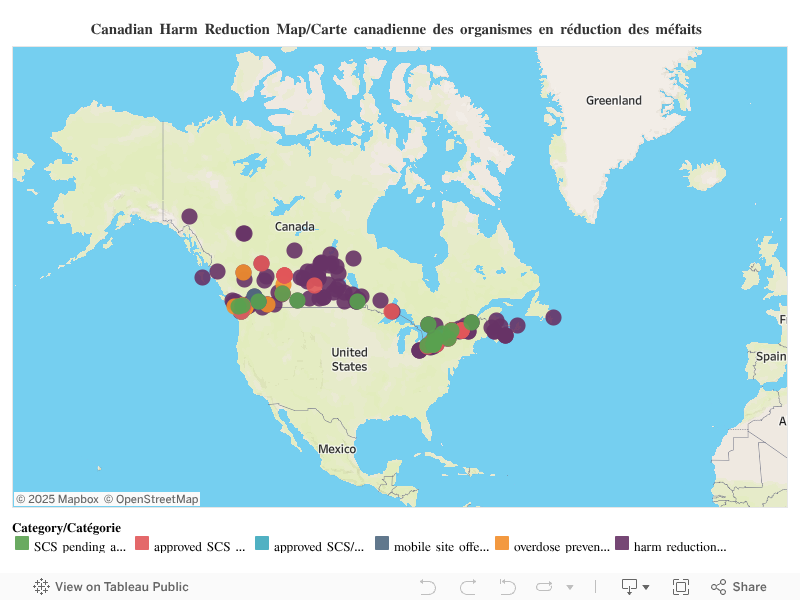
(Interactive Map)
To be fair, the federal Liberals have done a vastly better job than the Conservatives would have in the area of harm reduction. During their five years in power they approved at least 40 supervised consumption sites (including mobile sites) and streamlined the process to applying for and opening these life-saving facilities. They have also begun to explore safe supply initiatives; and in general taken steps in the right direction, but never enough or with large enough strides to prevent the catastrophic loss of life unfolding across Canada. It is now time to take those steps. They have both the time, and support to do so. We hope to see not only more supervised consumption sites, but more stable funding and resources for those already saving countless lives every day.
With a new mandate and two
parties supporting bold policy changes, Justin Trudeau has more latitude than
ever to do what is right. It is precisely during times of crisis such as this
where leadership is tested, and leadership can shine. We hope this will be one
of those moments.
The
award is the university’s first-ever honourary doctorate in Canada and
recognizes the overdose and drug poisoning crisis as a critical human rights
and social justice issue of our time
VANCOUVER, BC—Donald MacPherson, executive director of the Canadian Drug Policy Coalition and author of the seminal Four Pillars Drug Strategy, today received Adler University’s first-ever honourary doctorate in Canada. The university chose MacPherson for his pioneering work in drug policy reform, advocacy, and advancing the human rights and social inclusion of people who use substances.
“Donald
MacPherson exemplifies the social justice work that we pursue at Adler
University,” said Joy MacPhail, Chair of the Board of Trustees at Adler
University. “His cutting-edge efforts aim to improve public health and safety
by reforming drug policies and by promoting the human rights of people who use
substances. His work reminds us how much more needs to be done to address the
overdose crisis and we hope our graduates are inspired by MacPherson’s advocacy
to advance social justice throughout their careers.”
The
award is also a recognition of the tragic loss of life caused by the illicit,
unregulated drug market—a product of our flawed drug policies—as a defining
human rights and social justice issue of our time. “I am honoured to receive
this award from Adler University and the acknowledgement that the work to
change archaic and harmful public policies is one of the challenges of our
times,” said MacPherson. “We are living through a time of catastrophic failure of
the way we approach people who use criminalized drugs. Our systems are terribly
broken and must be replaced.”
In Canada, 12,813 people have died from opioid-related deaths between 2016 and March 2019. Life expectancy has failed to increase for the first time in over four decades; and in British Columbia, overdose death is now the largest major cause of unnatural death, outpacing accidental deaths from homicides, suicides, and car accidents combined. The provinces of Alberta and Ontario have also been especially hard hit, with Ontario last year recording a record number of fatalities from overdose.
“We are living through a time of catastrophic failure of the way we approach people who use criminalized drugs. Our systems are terribly broken and must be replaced.”
~Donald MacPherson, Canadian Drug Policy Coalition
MacPherson has been a guest lecturer for Adler University’s public policy and administration program. All Adler University graduate-level degree programs are strongly rooted in the principles of social justice and offer students hands-on learning experiences at more than 200 community partner organizations. Many students work at organizations that address the overdose crisis, providing mental health and other services.
MacPherson is also an adjunct professor in Simon Fraser University’s Faculty of Health Sciences, of which the Canadian Drug Policy Coalition is a part, and co-author of Raise Shit! Social Action Saving Lives (2009) and More Harm than Good: Drug Policy in Canada (2016). He is involved in drug policy work at a local, national, and international level and was North America’s first Drug Policy Coordinator at the City of Vancouver where he worked for 22 years. Full bio here.
Contact
Peter Kim Strategic Communications Manager Canadian Drug Policy Coalition [email protected] 604-787-4043
The Canadian Drug Policy Coalition (CDPC) is a coalition of 60 organizations and 7,000 individuals working to support the development of progressive drug policy grounded in science, guided by public health principles, and respectful of human rights. The CDPC operates as a project within Simon Fraser University’s Faculty of Health Sciences. The CDPC seeks to include people who use drugs and those harmed by the war on drugs in moving toward a healthier Canadian society free of stigma and social exclusion. www.drugpolicy.ca
About
Adler University
Adler University is committed to improving individual and community health and well-being through positive social change. At the centre of downtown Vancouver, Adler University is an independent nonprofit institution of higher learning that offers graduate degree programs in psychology, counselling, and public policy. Established in 1952, Adler University has campuses in Vancouver, Chicago, and online. Adler University’s mission is to continue the pioneering work of Alfred Adler, the first community psychologist, by graduating socially responsible practitioners, engaging communities, and advancing social justice. www.adler.edu
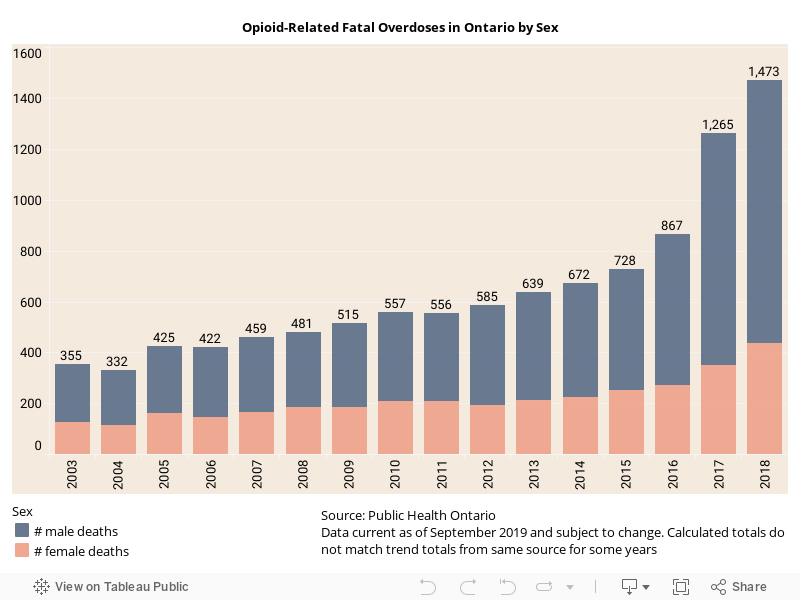
The answer to the headline’s question seems to be a resounding “no.” How else could one explain the catastrophic loss of life unfolding in Canada’s largest province. Nearly 1,500 people died in Ontario last year from accidental drug poisoning—a record number representing a two hundred per cent increase from a decade ago.
Behind each number was a human being—a friend or family member with aspirations and dreams in life cut short because of Canada’s fatally flawed drug policies. Prohibition is the root cause of this crisis, not the drugs people take.
And as communities continue to hemorrhage human lives, politicians with the power to enact life-saving change are failing to take the necessary steps that are proportional to the scale of this crisis: decriminalization and the legal regulation of drugs. It is considered too “politically risky” to embrace evidence-backed solutions people on the frontlines have been advocating since the beginning when those solutions run afoul of our outdated moral views on substance use.
And as people die, the federal government refuses to declare a national public health emergency for what Gillian Kolla, a harm reduction worker and public health researcher at the University of Toronto, called “the largest health crisis of our generation.”
Temporary overdose prevention site in Toronto, Ontario; 2017
At this critical point in Canada’s history, where complacency is fueling death, it has largely been volunteer networks of community activists and people who use drugs who have shown the courage to do what is needed by setting up overdose prevention sites to save lives. Without this leadership and conviction the death toll would have been exponentially worse, yet this community is continually fighting for resources and support from a provincial government that shows tepid interest in evidence-backed solutions. Premier Doug Ford himself has publicly stated his opposition to supervised consumption sites.
In this hostile climate, exhausted by grief and the wretched routineness of hearing about yet another fatal overdose, the frontline harm reduction community continues to save lives. Who else is there to do the work when much of society and government have turned their back on you?
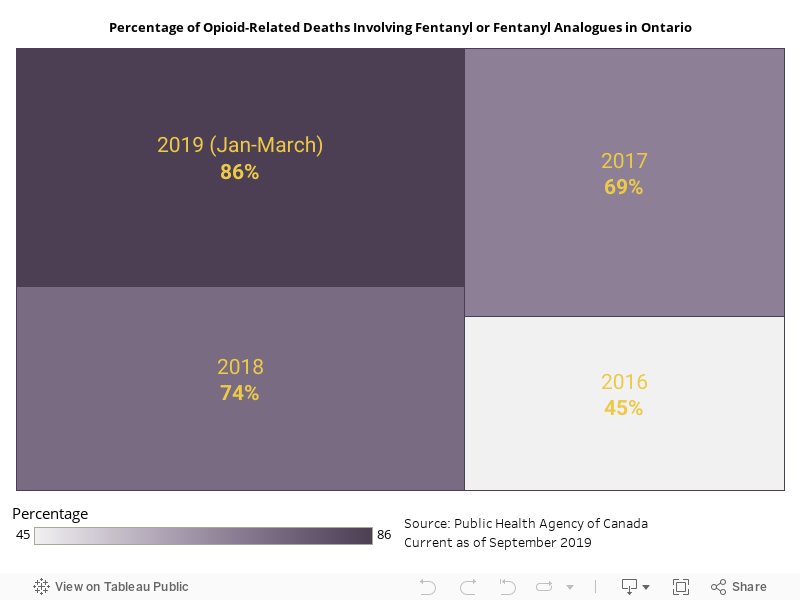
Government investment in harm reduction services and a commitment to peer-led initiatives have failed grow proportional to the dire need. Data from the Public Health Agency of Canada reveals a sharp increase in the presence of fentanyl and fentanyl analogues in Ontario’s drug supply; and at last check, almost 90% of fatal drug poisoning/overdose cases involved these substances.
(Interactive Graph)
This is a direct result of our current drug policies that rely on prohibition and criminalization of people who use drugs—a system founded on racism and colonialism whose legacy continues to disproportionately affect people of colour and Indigenous communities today.
“The largest health crisis of our generation.”
~Gillian Kolla, University of Toronto
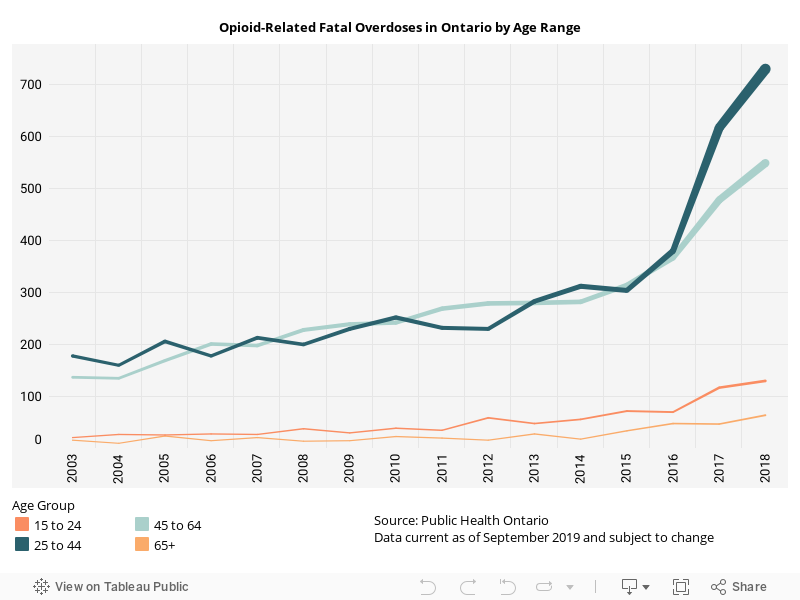
What is especially tragic is that the fatal overdoses most deeply affect those in the prime of their lives: Ontarians between the ages of 25 and 44. Across Canada, nearly 13,000 people have died from opioid-related causes in approximately three years. Last year, one person died every two hours, and for the first time in over four decades, life expectancy at birth has stopped rising because of overdose.
(Interactive Graph)
This is a crisis unlike any Ontario has seen before. The severe acute respiratory syndrome (SARS) public health emergency in 2003 killed 44 people, yet mobilized hundreds of thousands of dollars of funding and captured media headlines for weeks. It is clear that with respect to overdose and drug poisoning the lack of appropriate action is fueled by stigma and the biases society holds towards substance use and people who use drugs. History will remember unkindly the collective apathy of those who had the power to enact life-saving changes in this catastrophe yet didn’t. The current inaction is not about a lack of government resources, but rather a lack of will.
“Executions for drug offences are prohibited under international human rights law, as drug offences do not meet the threshold of ‘most serious crimes’ to which Article 6.2 of the International Covenant on Civil and Political Rights mandates that capital punishment be restricted, in retentionist countries. The INCB has repeatedly called on states that retain the death penalty for drug offences to commute all existing death sentences, and to consider abolishing the death penalty altogether”
“Your ministry and the Province bear responsibility to ensure the health and safety of people who use drugs. People continue to die as a result of a toxic drug supply, and the crisis continues to be exacerbated by the criminal enforcement of low-level drug offences, such as possession for personal use, and lagging health services and supports.”