Author: Canadian Drug Policy Coalition

  • Overdose prevention and response during COVID-19

    Overdose prevention and response during COVID-19

    Overdose prevention and response during COVID-19, Overdose prevention and response during COVID-19


    Click HERE for more resources

  • Syringe services program operational changes during COVID-19 outbreak

    Syringe services program operational changes during COVID-19 outbreak

    Syringe services program changes during COVID-19, Syringe services program changes during COVID-19,

    Click HERE for more resources

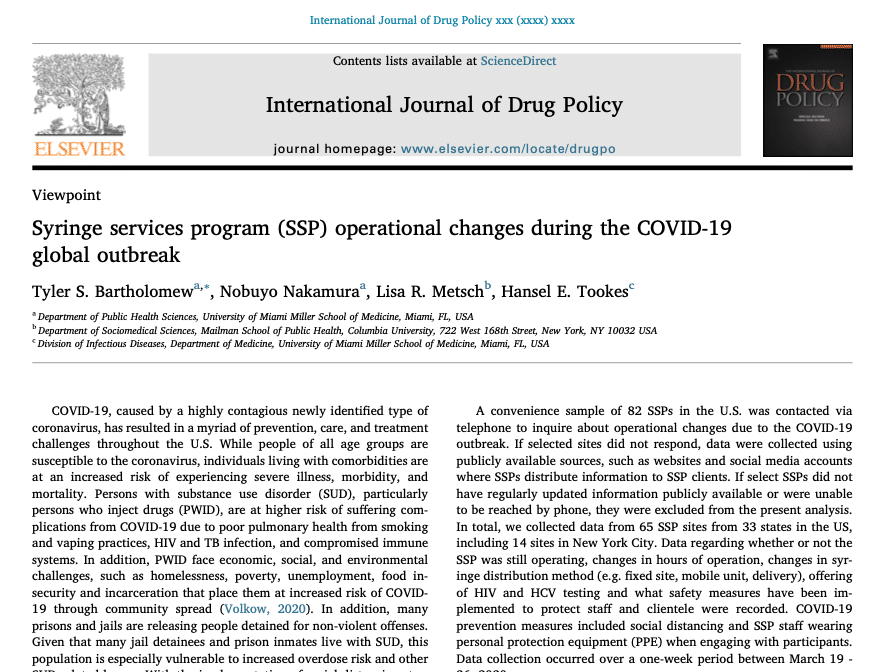
    “Syringe services program (SSP) operational changes during the COVID-19 global outbreak. Syringe services programs (SSPs) are community-based programs that offer tailored social and medical services to PWID, including access to sterile and clean injection equipment, onsite and referrals to sub- stance use treatment, HIV and Hepatitis C (HCV) testing, and overdose prevention through naloxone distribution. Currently, there are over 400 SSP locations across the United States (US) providing life-saving care to PWID. However, with the unprecedented developments regarding COVID-19, service delivery may be severely disrupted, and operational changes may be imperative to protect SSP staff and to ensure continuity of services. We provide preliminary data regarding SSP operational and service delivery changes during the US’ response to the COVID-19 global pandemic and provide key policy and service provision im- plications for SSPs.”

    Source: International Journal of Drug Policy

  • LETTRE OUVERTE : Les organisations de la société civile appellent à nouveau à la décriminalisation des drogues

    LETTRE OUVERTE : Les organisations de la société civile appellent à nouveau à la décriminalisation des drogues

    Hier, l’Association canadienne des chefs de police (ACCP) a publié un rapport recommandant de cesser la criminalisation de la possession simple de drogues (c’est-à-dire la possession pour usage personnel). L’association « convient que les donnéesempiriques, appuyées par les chefs de file du domaine de la santé, semblent indiquer que la décriminalisation pour la simple possession est un moyen efficace de réduire les effets nuisibles de la toxicomanie sur la santé publique et la sécurité publique ». Le rapport précise que « des arguments convaincants » ont été présentés en faveur d’un « changement transformatif » de l’approche actuelle du Canada en matière de possession de drogues. Nous applaudissons cette reconnaissance importante par les services de police et appelons le gouvernement fédéral à décriminaliser tout de suite.

    La demande de changement est de plus en plus forte. Les experts en santé publique et les organisations de la société civile à travers le pays plaident en faveur de la décriminalisation des drogues depuis longtemps. Maintenant, l’ACCP a publiquement ajouté sa voix à l’appel pour mettre fin à la criminalisation de la simple possession. La direction à prendre est claire : il faut adopter une décriminalisation complète qui élimine toutes les sanctions pénales et autres peines pour le délit de possession.

    Notre système actuel de criminalisation entraîne de nombreux dommages pour la santé publique et les communautés racialisées, en particulier le maintien de l’ordre excessif et la persécution des communautés noires et indigènes. La criminalisation est ancrée dans la stigmatisation et le racisme, et y contribue également. Cette pratique est néfaste et doit cesser.

    Le Canada peut remédier aux méfaits de la politique punitive en matière de drogues de façon simple et immédiate. La ministre fédérale de la Santé, Patty Hajdu, est en mesure de décriminaliser la simple possession de drogue en autorisant une exemption nationale pour cette infraction en vertu de l’article 56 de la Loi réglementant certaines drogues et autres substances.

    Il est inutile de tarder, et aucune excuse ne peut justifier un délai, surtout en cette période de décès par surdose sans précédent. Nous exigeons un plus grand investissement dans les services de santé, comprenant des options de réduction des méfaits et de traitement respectueux des cultures, ainsi que des efforts pour garantir un approvisionnement en drogues plus sûr que celui offert par les drogues toxiques du marché illégal. Mais ces actions doivent accompagner et non remplacer une décriminalisation immédiate. Il est possible et nécessaire de supprimer toutes les sanctions, qu’elles soient pénales, administratives ou autres, pour la simple possession de drogue aujourd’hui.

  • Medications and clinical approaches to support physical distancing for PWUD

    Medications and clinical approaches to support physical distancing for PWUD

    physical distancing for people who use drugs, physical distancing for people who use drugs


    Click HERE for more resources

    “This document is one in a series of six national guidance documents, developed rapidly by the CRISM network at the request of the Government of Canada. Collectively, the six documents address urgent needs of people who use substances, service providers, and decision makers in relation to the COVID-19 pandemic. The urgent nature of this work required rapid development and dissemination of this guidance. This, and the continuing evolution of the knowledge base regarding COVID-19, precluded CRISM from conducting a comprehensive review of the relevant literature. However, a significant number of works were consulted in drafting this guidance; a list of works consulted is provided in Appendix 1: Works Consulted on page 31.

    The guidance provided in this document is subject to change as new information becomes available. Readers should note that the intent of this document is to provide general guidance rather than detailed procedural and logistical advice. Readers are advised to consult local public health and medical authorities for specific input on navigating their own unique regulatory and policy environments, as necessary.”

    Source: CRISM

  • Supporting people who use drugs in acute care settings during COVID-19

    Supporting people who use drugs in acute care settings during COVID-19

    supporting people who use drugs in acute care, supporting people who use drugs in acute care


    Click HERE for more resources

    “This document is one of a series of six national guidance documents, rapidly developed by the CRISM network at the request of the Government of Canada. Collectively, the six documents address urgent needs of people who use drugs, service providers, and decision makers in relation to the COVID-19 pandemic. The urgent nature of this work required rapid development and dissemination of this guidance. This, and the continuing evolution of the knowledge base regarding COVID-19, precluded CRISM from conducting a comprehensive review of the relevant literature. However, when available, scientific evidence is cited in support of the expert advice offered herein.

    The guidance provided in this document is subject to change as new information becomes available. Readers should note that the intent of this document is to provide general guidance rather than detailed procedural and logistical advice. Readers are advised to consult local Public Health and medical authorities for specific input on navigating their own unique regulatory and policy environments, as necessary.”

    Source: CRISM

  • Reducing COVID-19 Spread in Recovery Programs & Treatment Services

    Reducing COVID-19 Spread in Recovery Programs & Treatment Services

    reducing COVID-19 transmission in recovery and treatment programs, reducing COVID-19 transmission in recovery and treatment programs


    Click HERE for more resources

    “This document is one in a series of six national guidance documents, developed rapidly by the CRISM network at the request of the Government of Canada. Collectively, the six documents address urgent needs of people who use substances, service providers, and decision makers in relation to the COVID-19 pandemic. The urgent nature of this work required rapid development and dissemination of this guidance. This, and the continuing evolution of the knowledge base regarding COVID-19, precluded CRISM from conducting a comprehensive review of the relevant literature.

    The guidance provided in this document is subject to change as new information becomes available. Readers should note that the intent of this document is to provide general guidance rather than detailed procedural and logistical advice. Readers are advised to consult local public health and medical authorities for specific input on navigating their own unique regulatory and policy environments, as necessary.”

    Source: CRISM

  • Telemedicine support for addiction services

    Telemedicine support for addiction services

    telemedicine support for addiction services, telemedicine support for addiction services


    Click HERE for more resources

    “This document is one of a series of six national guidance documents, rapidly developed by the CRISM network at the request of the Government of Canada. Collectively, the six documents address urgent needs of people who use substances, service providers, and decision makers in relation to the COVID-19 pandemic. The urgent nature of this work required rapid development and dissemination of this guidance. This, and the continuing evolution of the knowledge base regarding COVID-19, precluded CRISM from conducting a comprehensive review of the relevant literature. However, when available, scientific evidence is cited in support of the expert advice offered herein.

    The guidance provided in this document is subject to change as new information becomes available. Readers should note that the intent of this document is to provide general guidance rather than detailed procedural and logistical advice. Readers are advised to consult local public health and medical authorities for specific input on navigating their own unique regulatory and policy environments, as necessary.”

    Source: CRISM

  • Expanded Response Options to Opioid Harms: Case Study from Four Cities

    Expanded Response Options to Opioid Harms: Case Study from Four Cities

    CCSA case study, CCSA case study

    Click HERE for more resources

    “Canada is facing an urgent challenge to reduce the harms associated
    with the problematic use of opioids. More than 14,700 lives were lost to deaths apparently related to opioids between January 2016 and September 2019. During that same period, there were 19,490 hospitalizations for poisoning related opioid to opioids (Special Advisory Committee on the Epidemic of Opioid Overdoses, 2019). The COVID-19 pandemic compounds this ongoing public health crisis. There is a heightened need to reduce avoidable pressures on healthcare systems and support people who use opioids who may be at increased risk or unable to self-isolate during the pandemic.”

    Source: Canadian Centre on Substance Use

  • Harm Reduction and COVID-19 Guidance for Service Providers

    Harm Reduction and COVID-19 Guidance for Service Providers

    Alberta health services covid guidance, Alberta health services covid guidance


    Click HERE for more resources

    “This guidance document for community service providers was prepared by the Alberta Health Services (AHS) Harm Reduction Services Team in partnership with the Alberta Community Council on HIV (ACCH). It covers information on how community services may alter harm reduction practices during the COVID-19 pandemic with the goal of reducing the spread of COVID-19. This information can also be used by service providers to communicate information and education on reducing spread of COVID-19 while maintaining health and wellness along the spectrum of substance use.”