Decriminalization Done Right Decriminalization Done Right
SIGN ON LETTER: As organizations and individuals committed to the liberation of people who use drugs, and progressive, rights-based drug policy reforms including decriminalization, we, the undersigned, call on the City of Vancouver to address three major concerns regarding its current application to the federal Health Minister to decriminalize simple drug possession locally. We also call on Health Canada and the federal Health Minister, Patty Hajdu, to refrain from imposing unnecessary and unjustified restrictions on any exemption issued to enable decriminalization in Vancouver or other municipalities or provinces that may follow suit, and we call on the Vancouver Police Department to stand down, vacate the process of decriminalization, and sign off on community-established thresholds [Read more]
#DecrimDoneRight involves co-development with people who use drugs.
Contact us to add your organization’s name to the letter
Support drug policies rooted in social justice, compassion, and evidence. Sign up for our newsletter to get updates and learn how you can take action with us.
Signed,
AIDS Network Kootenay Outeach and Support Society Amnesty International Canada Association des intervenants en dépendance du Québec (AIDQ) AVI Health and Community Services BC Association of Aboriginal Friendship Centres BC Civil Liberties Association Brockville’s Overdose Outreach Team Canadian Association of People Who Use Drugs (CAPUD) Canadian Drug Policy Coalition Canadian Students for Sensible Drug Policy (National) Canadian Students for Sensible Drug Policy Vancouver Canadian Psychedelic Association Centre on Drug Policy Evaluation Community-Based Research Centre Each+Every East Kootenay Network of People who Use Drugs Harm Reduction Nurses Association HIV Legal Network Moms Stop the Harm Pivot Legal Society South Riverdale Community Health Centre (Toronto) Thunderbird Partnership Foundation
“During COVID-19 and its aftermath it is important to consider the impacts of the pandemic and social and physical isolation on women’s health. This sheet explores adaptations to practice for service organizations and frontline workers, to respond to concerning trends in intimate partner violence (IPV) and substance use in the COVID-19 context.” Source: CCSA
Support drug policies rooted in social justice, compassion, and evidence. Sign up for our newsletter to get updates and learn how you can take action with us.
Vancouver model for decriminalization Vancouver model for decriminalization
We write now to urge you to develop a “Vancouver Model” for decriminalization that is appropriately broad and responds to the aspirations and needs of people who use drugs: principally, an exemption must apply to all substances scheduled under the CDSA, to all quantities of substances where possession is for personal use (regardless of the amount possessed), to all instances of transferring drugs (e.g,. splitting, sharing, selling) of quantities below specified thresholds, and must not include other unnecessary restrictions or conditions (administrative or otherwise) that would undermine the benefits of decriminalization.
Support drug policies rooted in social justice, compassion, and evidence. Sign up for our newsletter to get updates and learn how you can take action with us.
On January 1, 2021, I hopped on my bicycle and rode from Saskatoon to Vancouver on a project called Cycle to Stop the Harm, to raise awareness around the drug poisoning crisis, drug policy reform, and mental health. Along with awareness and outreach, I raised money for Moms Stop The Harm and the Canadian Drug Policy Coalition—two amazing groups among many working at the leading edge of drug policy reform, outreach, and education. Full of determination, I left with a fundraising goal of $20,000 and a bicycle packed with everything I needed to survive winter camping and cycling from the prairies, through the mountains, and to the west coast. After 29 days and roughly 1670 kilometres, I successfully arrived in Vancouver with all my toes and fingers on January 29, 2021 with a total of $25,450 raised. Above all, this meant a voice for tens of thousands of people who are otherwise unheard and a chance to raise awareness around the current drug poisoning epidemic.
Iliajah Pidskalny; 2021
During that month, I received many questions: Why bicycle? Why winter? Why during a pandemic? What did you eat? Why peanut butter? What motivated you when it was most challenging? What was your training like? What will you do afterwards? Is there a personal connection to this issue? And the most common and most important question: what harm are you referring to?
The simple response to the latter is the harm done by our current drug policies, which have been a failed model for decades. The “war on drugs” is a useful term as it emphasizes the aggression of our current approach which, like war, costs a lot of money and many lives. After decades of failure, this model contradicts evidence, logic and human rights. The drug poisoning crisis is a manifestation of the harm caused by the war on drugs and is a serious epidemic taking the lives of thousands of people.
Ready to help?
Support drug policies rooted in social justice, compassion, and evidence. Sign up for our newsletter to get updates and learn how you can take action with us.
Is there a personal connection?
No, I do not have a personal connection to overdose nor fentanyl poisoning. However, I am a human, and so I have a personal connection to other humans. I am embarrassed about this pitiful and devastating “war on drugs,” the policies of which are illogical and unjust. The policies have been justified by miseducation around drugs, drug use, and mental health, which has created a culture of stigma and accepted marginalization. Canada should take this issue more seriously before every Canadian has lost a loved one to fentanyl poisoning or overdose. There is no “us and them.” Taking a more empathetic and human rights approach to drug policies will not only expose systemic inequalities—whether socioeconomical, cultural, racial, or gender-based—it will also help us better understand mental health.
So when asked, “What harm are you referring to?”
I was ultimately referring to the harm caused by our own mind. Whether we’ve lost a loved one or are genetically prone to depression, our mind is at the root of so much suffering. Cycle to Stop the Harm was about mental health. Drug policy reform is the perfect place to increase research, understanding, and compassion regarding mental health and to decrease stigma (not to mention save tens of thousands of lives). Whether it’s depression, loneliness, anxiety, addiction, greed, hatred, or jealousy, we are all susceptible to mental and emotional ailments. That is the essence of why I began Cycle to Stop the Harm. That is why I was so motivated to bring awareness to this issue even if it meant the constant threat of hypothermia and frostbite for 29 days. I was riding for every boy and girl lost to fentanyl poisoning and for every mother and father who now suffers from their loss. I was riding for impoverished communities in Canada, Ghana, Mexico and every other country. I was riding for the rich and the poor, the religious and the atheist, the young and the old. Each day on that bicycle, I rode for every individual human.
Why bicycle?
I knew that I could bicycle and camp in the winter. I knew that a crazy journey like this could get some attention. I knew that I could give a voice to so many people who don’t have the opportunity/resources to speak up (or be heard).
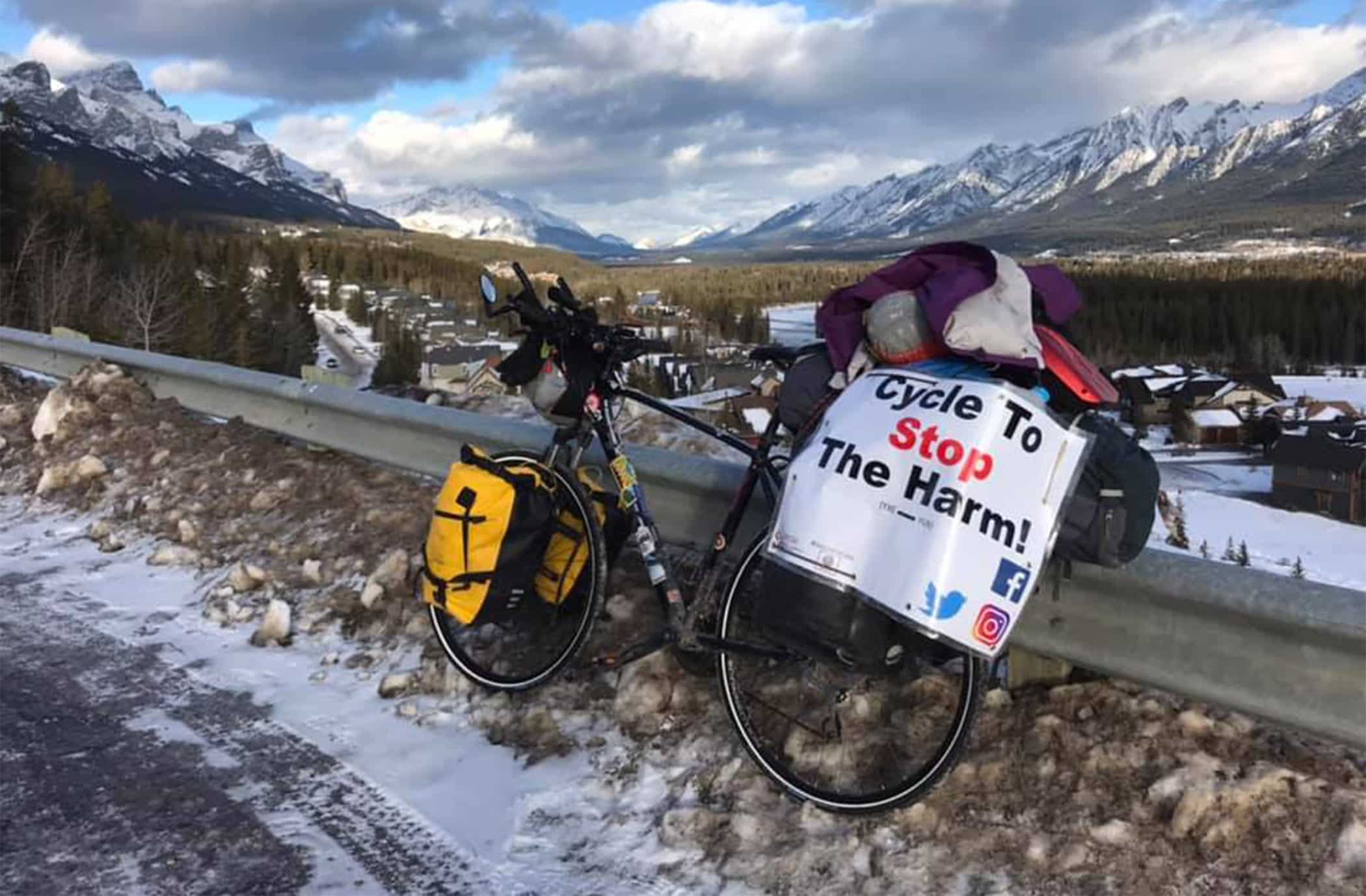
Saskatchewan highway; 2021
Why winter?
I got the idea mid-December and I was not willing to wait. People say I’m impatient, but I call it enthusiastic. I also knew my journey would gain much more attention in winter than in summer. Furthermore, riding and camping in the winter highlights some (and only some) of the challenges experienced by Canadians who are homeless. After witnessing homelessness during another six-week winter bicycle journey in eastern Canada (October 23 – December 3, 2020), I wanted people to rethink the challenges of homelessness. I often wondered why people would call me adventurous or brave, yet rarely said anything like that (or anything at all) to people who live on the streets. Living outside in the winter sucks, even if you have good gear and do it by choice. I can’t imagine what it’s like involuntarily living without shelter and struggling with other barriers, including severe mental illness and stigma.
Why during a pandemic?
Although the world’s in the grips of a tragic pandemic, homelessness, addiction, depression, suicide, mental illnesses, and social inequalities don’t stop. In fact, overdose and suicide have only gone up in many communities during this time. For me personally, I wasn’t going to wait until the pandemic was “over” until I cared about these issues. I followed all pandemic protocols and was willing to take the extra challenges involved, which meant living/cycling for two weeks in a tent by myself until I could be hosted in a home. That totalled two warm homes in the month of January, and not nearly enough showering…
As for the journey itself, I’ll try to summarize some of the challenges.
Thanks to good gear, I was never cold during the night. However, every morning I had to crawl out of my warm sleeping bag and put on frozen socks, frozen boots, and frozen mitts. Overnight, my breath would precipitate as snow on the inside walls of my tent. This meant that any sudden movement, it would be snowing in my tent. I had spare dry socks, but my boots were wet (frozen), so I saved them for emergency (which was never, thankfully). Day after day, everything got more wet and more frozen.
Camping along Cycle to Stop the Harm route; 2021
After I put my frozen socks and mitts on, I would then pack up camp in the dark so that I could ride at dawn. Since I had limited daylight (especially in the beginning), I would cycle from dawn to dusk. It took a lot of time and energy to make and pack up a good winter camp everyday. I had to bicycle at least 80 km a day for it to be worthwhile. Riding 80 km was tough against prairie headwinds (consistently 50 km/hr and sometimes gusting up to 90 km/hr), but in the mountains I started averaging 120 km a day.
Once camp was packed up and the bike was ready to go, one of the hardest parts was next: shedding some layers before cycling. That always sucked. Singing and talking hysterically seemed to help. It was just a matter of cycling hard until my body would generate enough heat such that the involuntary and lifesaving shivers would stop. But, before that moment, the bitter cold seemed to desperately draw physical and mental energy out of me… day after day. Once I was fully warmed up, I cycled with only a long sleeve shirt, thin polyester leggings, and swimming trunks. Then to the next hardest part: stopping for a break. If I stopped, I would get extremely cold, shivering and teeth chattering within a few minutes (or sometimes seconds). Standing in middle-of-nowhere Canada with a shiver like that is a quick trip to severe hypothermia. My only source of heat was my body via exercise. So, I would rarely stop and only briefly. A quick sip of water (which had to be stored in a thermos) and a quick handful of as many calories as possible before cycling again. I noticed that bicycling with a mouthful of food, trying not to choke and wearing a face mask all at once was a quick way to warm up after a break.
What did I eat?
Each morning and evening I ate rice noodles with peanut butter. But to sustain me for the rest of the day, I would make energy bars from dates, chocolate, peanut butter and tortilla chips. After cycling all day, I would always get a nasty chill when I finally stopped riding in the evening. The only way to shake the chill was to set up camp as fast as I could (which worked surprisingly well every time). Then I would cook my rice noodles for dinner, often with vegetable juice or canned tomatoes and of course, peanut butter. I ate other things along the journey, especially candy in Saskatchewan and potato chips in Alberta. But, once I learned that the combination of dates, chocolate, peanut butter, and tortilla chips made me feel invincible, I never looked back. And so it was, for 29 days.
Eating a meal during Cycle to Stop the Harm; 2021
Why peanut butter?
For those who had followed the journey on social media, they noticed a consistent theme of peanut butter. It was in part a joke, but also the majority of my caloric intake. This is because it is cheap, but also because I have some serious gut health issues (IBS). My health issues have almost convinced me to stop travelling and doing adventures like this, but I’ve decided instead to adjust my lifestyle (diet) in a way that allows me to do the things that I love most. Of course, I’ve had to redefine what it is that I love most; but that, combined with peanut butter allows me to push on. (I share this to help remind people that I’m human, and to not over-romanticize my character qualities).
What motivated me when it was most challenging?
I met many people along the journey and everyone had a story—whether it was losing a friend to fentanyl poisoning or their own story about alcoholism, using heroin, or addictive shopping. Everyday, I would be reminded about who and what I was riding for: everyone and their mental health. When my toes were numb or the headwinds were gusting 90 km/hr, I just had to remind myself, “This isn’t about you, Iliajah. This is about everyone, including you.” I would look up at the mountains and think, “Be patient like the mountains, strong like the wind, and humble like the dust.”
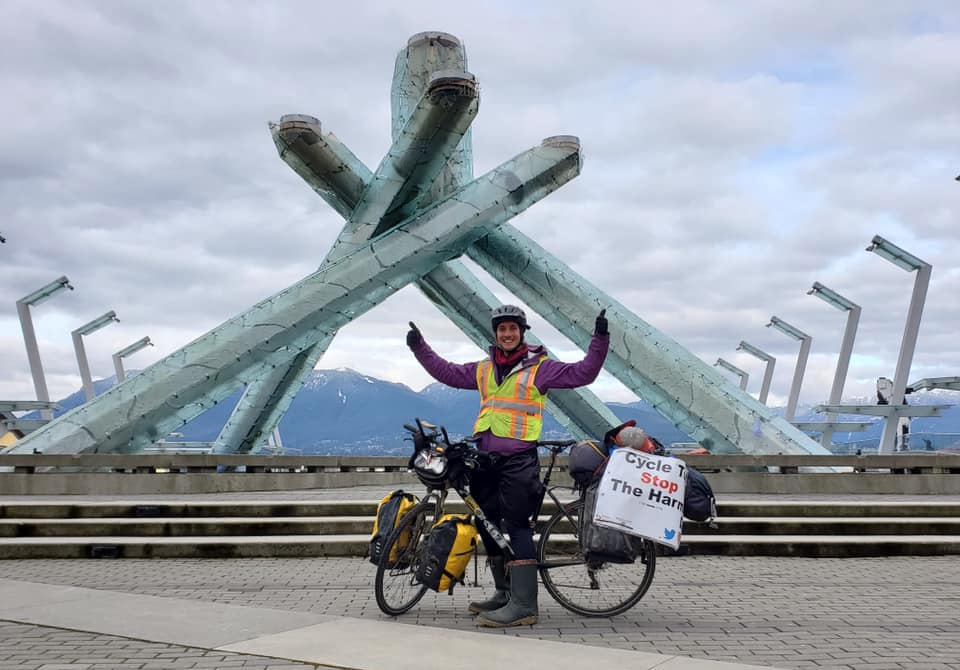
During the month, I rarely thought about my final destination. Instead, I focused on one day at a time. Cycling and camping in the cold requires a lot of focus, and there was little time for me to celebrate or relax. Every minute was highly calculated, as I constantly danced with the threat of hypothermia and frostbite. However, when I left Manning Park at -20C one morning and arrived in Agassiz at +8C the same afternoon, I felt an overwhelming sense of relief. At that moment, I knew that I had successfully completed the journey and that I would safely arrive to Vancouver in only a few more days. By the time I arrived at my official final destination, Jack Poole Plaza (at the Olympic Flame) in Vancouver, I only felt an inexplicable exhaustion from my journey and an excitement for what lay next.
Jack Poole Plaza; Vancouver; 2021
What was my training like?
I spent the last six years without a vehicle, which meant many winters and many long distance bicycle rides. My first journey was from Saskatoon to Vancouver (in the summertime when I was 18 and with a buddy), and I fell in love with long distance cycling. Since then, I’ve done long hauls in Indonesia, Cambodia, Spain, and others in Canada. My legs were ready for Cycle to Stop the Harm. However, winter is a different beast and so this time my training was focused on my mind. I’ve been lucky enough to have the time, energy, and resources (books, wifi, people) to have stumbled upon and practiced meditation. This was the key to the empathy and compassion that motivated me to embark on a bicycle journey in the dead of winter for no one in particular, yet every particular person.
What did I do afterwards?
I went to Vancouver Island and continued to bicycle for Cycle to Stop the Harm. I had closed the fundraiser and decided to focus on conversation and reducing stigma. I thought it would be a more relaxed version of my month in January, but I was very wrong. It was another month full of numb hands and feet, with wet shivering and teeth chattering battles against hypothermia. It was far more challenging than the first month because there was no endpoint. Less people were paying attention, and so my life threatening efforts felt pointless. Alas, I rode another ~500 km from Nanaimo to Campbell River, then south to Victoria, and then finally back to Nanaimo. The project ‘Cycle to Stop the Harm’ has since been put to rest, while I take some time to heal and stop harming my aching body. But, as the days get warmer and the sun shines longer, I can smell ideas blooming in my mind. The next project awaits, and will blossom when the time is right.
Edmonton, AB—Canadian Association of People Who Use Drugs, Canadian Drug Policy Coalition, Friends of Medicare, Moms Stop the Harm, and HIV Legal Network are deeply concerned about the health and safety impacts to vulnerable individuals accessing life-saving injectable opioid agonist treatment (iOAT) in Alberta.
Yesterday, a court ruling upheld a decision by the Government of Alberta to end iOAT at clinics in Calgary and Edmonton by dismissing an injunction application to keep these vital, life-saving services running at those clinics. In our view, the ruling does not take into account the lived experience and perspectives of people who use drugs who attested to the benefits of the program and how ending it would threaten their health and safety. Earlier, the court heard that individuals suffering from severe opioid use disorder could face “irreparable harms including risk of death” if the government-funded treatment program is halted in March as planned. This included evidence that the Government’s decision to close the clinics has already contributed to severe harm to patients.
The current iOAT program, prior to the Province creating uncertainty with its decisions, had a reported retention rate of over 80%, which is much above typical rates for substance use treatment. The Province of Alberta has in the past stated that addiction treatment should include services that support people beyond their substance use, something this program has done. It offers wrap around care, including on-site social workers who connect people with housing, income and employment support, psychologists and psychiatrists who help people deal with their underlying issues, including trauma, and most importantly peers with lived experience who understand and relate to the challenges the iOAT patients are going through. All this has contributed to the success of the iOAT program and has saved lives. This wrap around support will not be available in the unspecified model proposed by the Province.
Ready to help?
Support drug policies rooted in social justice, compassion, and evidence. Sign up for our newsletter to get updates and learn how you can take action with us.
The recent ruling could result in individuals relying, once again, on a toxic supply of drugs from an unregulated, dangerous market outside a medical/community context and thus being exposed to the potential for further irreparable harm. It relied on an incomplete understanding of opioid use disorder and a lack of literacy around substance use, addiction, and the lives of people who use drugs. Once again, the voices and perspectives of people who use drugs—who are experts in their own experience—were not given sufficient weight in a decision directly impacting their health and wellbeing.
Justice Dunlop, in his ruling, is quoted stating, “a causal connection between the Province’s planned changes and iOAT patients returning to street opioid use has not been proved.” But harms have already surfaced due to the Alberta government’s transition planning over the last year. The evidence before the court demonstrated that the Government’s decision has already contributed to one death and other serious harm for patients. Patients anticipate experiencing further serious, and irreversible harm once the clinics are shuttered.
This ruling is especially concerning given the climate we now see ourselves in: two concurrent public health crises and a rise in overdose deaths across Canada due to COVID-19. It is precisely in times such as these that health services like iOAT should be expanded rather than scaled back. The decision to end these services in March is unconscionable and will risk the wellbeing of the plaintiffs in this trial. As individuals affected by the drug poisoning crisis, concerned citizens, health service providers, and professionals in the field, we are deeply troubled by the adverse health impacts that could follow from this decision. Lives are at stake.
Contacts
Natasha Touesnard, Executive Director Canadian Association of People Who Use Drug [email protected] | 902-223-9151
Kym Porter, Alberta advocacy leader Moms Stop the Harm [email protected] | 403-580-7051
Petra Schulz, Co-FounderMoms Stop The Harm [email protected] | 780-708-2244
Alyssa Pretty, Communications and Administrative Officer Friends of Medicare [email protected] | 780-423-4581
Corey Ranger RN BN Albertans for Ethical Drug Policy [email protected] | 250-880-0415
Peter Kim, Director of Communications and Digital Engagement Canadian Drug Policy Coalition [email protected] | 604-787-4043
Janet Butler-McPhee, Director of Communications and Advocacy HIV Legal Network [email protected] | 647-295-0861
About Canadian Association of People Who Use Drugs
The Canadian Association of People who Use Drugs (CAPUD) is the national drug user organization in Canada. Our board and staff are comprised entirely of people who use(d) drugs. One of our main purposes is to empower people who currently use drugs deemed illegal to survive and thrive, with their human rights respected and their voices heard. We envision a world where drugs are regulated and the people who use them are decriminalized. We are survivors of this war and we’ll continue to fight for policy reform that is based in evidence, understanding and compassion.
About Canadian Drug Policy Coalition
The Canadian Drug Policy Coalition (CDPC) is a coalition of over 60 organizations and 7,000 individuals working to support the development of progressive drug policy grounded in science, guided by public health principles, and respectful of human rights. CDPC operates as a project within Simon Fraser University’s Faculty of Health Sciences. CDPC seeks to include people who use drugs and those harmed by the war on drugs in moving toward a healthier Canadian society free of stigma and social exclusion.
About Moms Stop the Harm
Moms Stop the Harm (MSTH) is a network of Canadian families impacted by substance use related harms and deaths. We advocate to change failed drug policies and provide peer support to grieving families and those with loved ones who use or have used substances.
About HIV Legal Network
The HIV Legal Network, formerly the Canadian HIV/AIDS Legal Network, promotes the human rights of people living with, at risk of or affected by HIV or AIDS, in Canada and internationally, through research and analysis, litigation and other advocacy, public education and community mobilization.
About Friends of Medicare
Friends of Medicare is a provincial coalition of individuals, service organizations, social justice groups, unions, associations, churches and other organizations whose goal is to raise public awareness on concerns related to Medicare in Alberta and Canada.
Improving ventilation for covid-19 Improving ventilation for covid-19
“The following is an edited summary of a conversation with Dr. Jeffrey Siegel, Professor of Civil Engineering at the University of Toronto. Dr. Siegel is an expert on indoor air quality and ventilation. The conversation took place in late December, 2020. Some information was also added following the conversation by MAP.
Respiratory illnesses like COVID-19 are spread in a few ways, including through the air. When people are together indoors, infections can spread more easily. But there are things you can do to improve indoor air quality and help reduce transmission. While this is particularly urgent during the COVID-19 pandemic, improvements to indoor air quality are important long-term investments at any time. For example, these improvements can help reduce transmission of long-standing respiratory illnesses such as flu and tuberculosis.
Please note, the below focuses on airborne transmission, and does not address or replace other infection control measures such as masks, hand washing and the disinfection of surfaces.”
Support drug policies rooted in social justice, compassion, and evidence. Sign up for our newsletter to get updates and learn how you can take action with us.
Support drug policies rooted in social justice, compassion, and evidence. Sign up for our newsletter to get updates and learn how you can take action with us.
canadian drug policy coalition 2021 canadian drug policy coalition 2021
There’s no denying that 2020 was a disaster. The human toll can be expressed in numbers, but the impact and actual loss is incalculable. Friends, family, lovers and co-workers died—many alone, and most from failed drug policy.
Though many of us understandably want to forget about this past year, we must not overlook the courage, ingenuity, and determination that helped move the dial on public health, harm reduction, and drug policy. COVID-19 helped the public see and understand the dire health inequities plaguing Canadian society. Supervised consumption, decriminalization of drugs, and safe supply entered public discourse and consciousness in a way they hadn’t in the past. This was due to the work of frontline advocates and communities affected by the harms of prohibition.
International Overdose Awareness Day; Vancouver; 2020
Not only did the overdose epidemic continue to rage in 2020, but the addition of the COVID-19 pandemic meant that Canadians were isolated from their regular supports. COVID-19 may have finally brought some folks shelter, but it also came with an increased risk of overdose because these individuals were now living alone.
Ready to help?
Support drug policies rooted in social justice, compassion, and evidence. Sign up for our newsletter to get updates and learn how you can take action with us.
Looking forward, there is an enormous amount of work to be done in 2021. The illegal drug market is still tainted with poisoned drugs. Stigma and discrimination still push people into the shadows. Municipal and provincial governments continue to deny the evidence of harm reduction and its positive impacts. We must keep the pressure on as we endeavor to change the minds of our elected leaders and convince them to support progressive drug policy.
In 2021, the Canadian Drug Policy Coalition will train its focus on decriminalization and the legal regulation of drugs to help end the harms of the toxic drug market. We will do this through a range of major projects, each with its own audience and goal to push Canada towards a future free from drug policy-related harm.
Rally in support of Lethbridge Overdose Prevention Site; Lethbridge, AB; 2020
At the frontend of our efforts is, Getting to Tomorrow: Ending the Overdose Crisis, a national public health dialogue project aimed at helping Canadians realize that we all share the same goals: a safe and secure society free from the harms of a toxic drug supply. The project will bring together community leaders across Canada to identify shared values, goals, and a collective vision for change so that Canadians can work together towards solutions. Getting to Tomorrow aims to bridge the divide within communities that so often stands in the way of life-saving progress and build a broad base of public support that will help animate our other major initiatives and efforts.
Broken Drug Policies is a similar project focused in British Columbia hoping to leverage the gains in drug policy, already introduced at a provincial level, to accelerate drug policy reform. Broken Drug Policies will help the public understand how interconnected systems (health care, criminal justice, social services, employment) drive substance use and the power they as citizens have in influencing those systems to create change.
The Regulation Project will do a deeper dive into what a system of legal regulation of drugs could look like. Ultimately, it is only through a safer and regulated supply of drugs that the scourge of overdose deaths can end, and envisioning this future free from harm is a vital first step. As part of the project, CDPC will be consulting key stakeholders—principle among them people who use drugs—on what factors would ensure that a system of legal regulation would succeed. How would people access safer drugs? Who would have access to them? When and where could they these substances be obtained? All these questions will be explored to lay the blueprint for life-saving change.
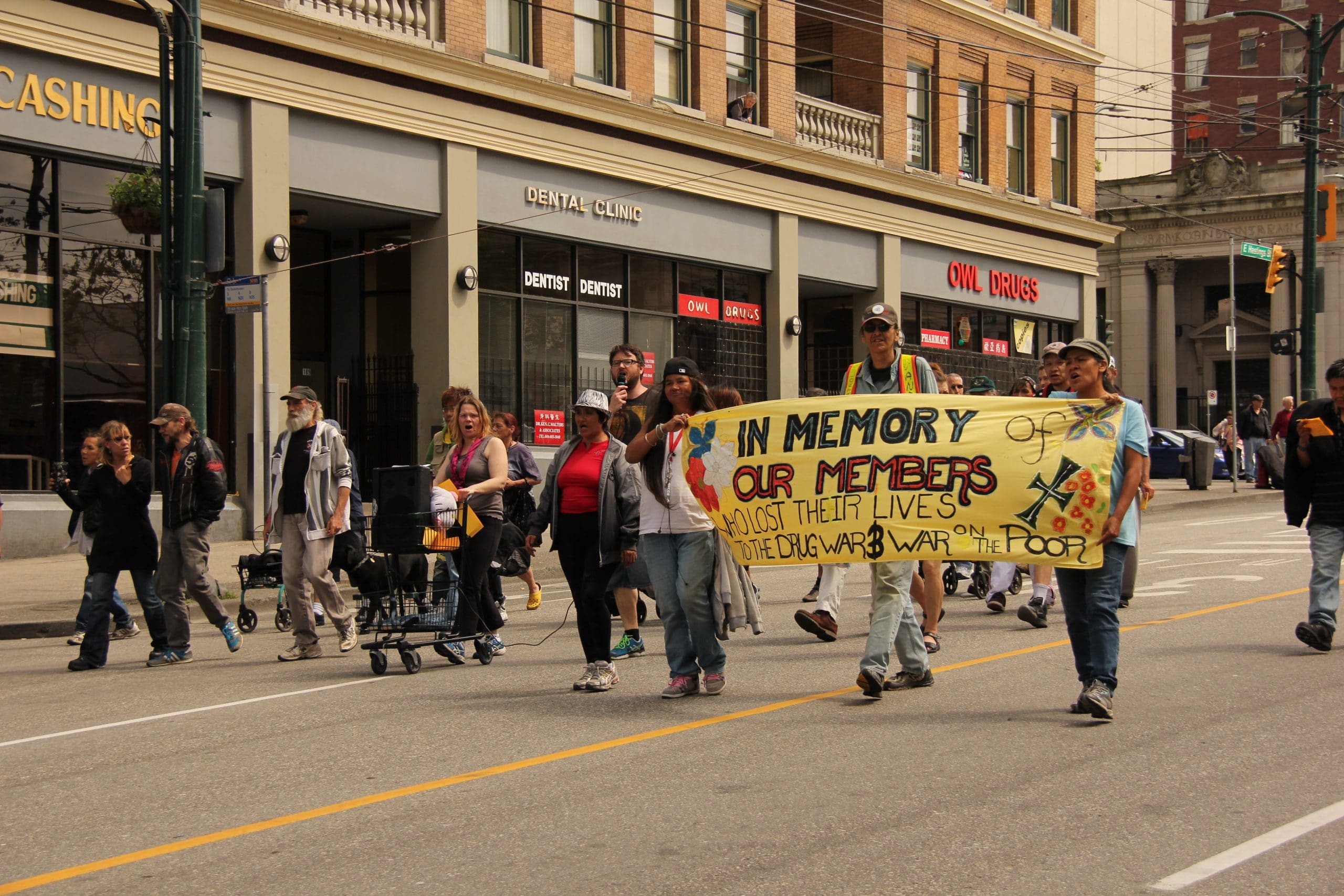
Vancouver Area Network of Drug Users Memorial March; Vancouver; 2020
Working alongside this effort is Imagine Safe Supply, which seeks to clearly articulate the concept of “safe supply” and what it means for those most directly impacted by the harms of our current drug policy: people who use drugs. Having a clear and accurate understanding of this concept is the necessary foundation for transformative policy.
With the rollout of COVID-19 vaccines we are happy to begin planning of Stimulus 2022: Drugs, Policy and Practice in Canada, the country’s largest harm reduction and drug policy conference that will bring together harm reductionists, people who use drugs, government, community leaders, advocates and academics to share knowledge and build community and capacity to better respond to the worst overdose crisis in Canadian history.
As we look to 2021, we look with hope. We need to come together now more than ever as we walk this tremendous path to change failed drug policies and save lives. We hope that you’ll walk alongside us.
Vancouver, Coast Salish Territories – Today, the Mayor of Vancouver, supported by Vancouver Coastal Health, announced a motion that could lead to the decriminalization of simple drug possession in Vancouver. If the motion is passed, Vancouver City Council will request an exemption from the federal government — under the Controlled Drugs and Substances Act — that would protect all people in Vancouver from the enforcement of simple drug possession as a criminal offence. If implemented properly, this could eliminate all criminal consequences for possessing drugs for personal use. Decriminalization would be a critical move towards addressing record overdose deaths and rampant stigma against people who use drugs, reducing barriers to accessing services, and avoiding ineffective and unnecessary use of public funds.
In May, Pivot Legal Society, the Canadian Drug Policy Coalition (CDPC), and the HIV Legal Network called on the federal government to use this same exemption power to decriminalize simple drug possession. To date, more than 170 civil society organizations have endorsed this call. Following their October release of a report on drug decriminalization in Vancouver, Pivot launched an email petition urging Vancouver’s Mayor and Council to apply for a local exemption and take more meaningful action than simply calling on other levels of government to do the right thing. Last week, the HIV Legal Network released a primer for municipal and provincial governments on why and how to request an exemption from the federal Health Minister to effectively decriminalize simple drug possession.
Ready to help?
Support drug policies rooted in social justice, compassion, and evidence. Sign up for our newsletter to get updates and learn how you can take action with us.
Pivot, CDPC, and the HIV Legal Network welcome Vancouver’s leadership in seeking to curb an ineffective and deadly war on people who use drugs. We urge City Councillors to quickly and unequivocally adopt the proposed motion as presented, without proposing administrative sanctions or other amendments that would weaken its positive outcomes. In addition, we urge cities and provinces across the country to take similar action. Inaction will only lead to more preventable deaths and infections. Caitlin Shane, Drug Policy Staff Lawyer at Pivot Legal Society, says all municipalities and provinces must urgently tackle the drug policy crisis ravaging communities across the country:
“Overdose fatalities have ballooned during COVID-19, far surpassing the number of fatalities caused by the coronavirus itself. Criminalizing people who use drugs is a public health disaster that causes untold harms to poor and racialized communities. Decriminalization is a key step towards reducing over-policing and rampant incarceration, and re-allocating funds to health, harm reduction, and safe supply efforts.”
Scott Bernstein, Director of Policy at CDPC, calls the announcement bold and necessary:
“A growing chorus of civil society and rights organizations, the Canadian Association of Chiefs of Police, public health officers, and people who use drugs across the country have decried the failure of drug prohibition and significant harms caused by treating a public health crisis as a criminal law issue. We are pleased that Vancouver is heeding these calls.”
Sandra Ka Hon Chu, Director of Research and Advocacy at the HIV Legal Network, urges other cities, provinces, and territories to follow Vancouver’s lead and apply for a similar exemption:
“Policymakers have a responsibility to adopt measures that uphold the health and safety of people who use drugs in their respective jurisdictions. Requesting an exemption from the federal Minister of Health is simple and vital. Municipal and provincial actors can take concrete actions now to move from harmful, failed criminalization to evidence-based public health approaches that respect human rights.”
Peter Kim, Canadian Drug Policy Coalition Email: [email protected] Direct: 604-787-4043
Janet Butler-McPhee, HIV Legal Network Email: [email protected] Direct: 647-295-0861
About Pivot Legal Society
Pivot Legal Society is a leading Canadian human rights organization that uses the law to address the root causes of poverty and social exclusion in Canada. Pivot’s work includes challenging laws and policies that force people to the margins of society and keep them there. Since 2002 Pivot has won major victories for sex workers’ rights, police accountability, affordable housing, and health and drug policy. http://www.pivotlegal.org/our_story
About Canadian Drug Policy Coalition
The Canadian Drug Policy Coalition (CDPC) is a coalition of over 60 organizations and 7,000 individuals working to support the development of progressive drug policy grounded in science, guided by public health principles, and respectful of human rights. CDPC operates as a project within Simon Fraser University’s Faculty of Health Sciences. CDPC seeks to include people who use drugs and those harmed by the war on drugs in moving toward a healthier Canadian society free of stigma and social exclusion. https://drugpolicy.ca/
About HIV Legal Network
The HIV Legal Network, formerly the Canadian HIV/AIDS Legal Network, promotes the human rights of people living with, at risk of or affected by HIV or AIDS, in Canada and internationally, through research and analysis, litigation and other advocacy, public education and community mobilization. http://www.hivlegalnetwork.ca/