Author: Canadian Drug Policy Coalition

  • Expanding access to diacetylmorphine & hydromorphone in Canada

    Expanding access to diacetylmorphine & hydromorphone in Canada


    Click HERE for more resources

    Abstract: The increasing incidence of fatal opioid overdose is a public health crisis in Canada. While buprenorphine/naloxone and methadone are the standard first-line of opioid substitution options, limitations, including difficulty achieving long-term retention for some people who use opioids, are well known. For this group, injectable diacetylmorphine or hydromorphone can achieve positive outcomes, including high retention rates, reduced use of unregulated opioids, and reduced criminal activity.

    In May 2019, Health Canada announced changes to increase the accessibility of diacetylmorphine and hydromorphone, and in September 2019, the CIHR-funded Canadian Research Initiative in Substance Misuse released a national clinical guideline for diacetylmorphine and hydromorphone as additional frontline substitution options.

    While these developments present opportunities for scale-up, significant financial, structural, and practice barriers continue to impede access. This commentary explores the current state of policy and practice for diacetylmorphine and hydromorphone as opioid substitution options in Canada, outlines the rationale for rapid expansion of access, and highlights clinical and policy changes that must be undertaken or the death toll will continue to rise.

  • Sex and Coronavirus Disease 2019 (COVID-19)

    Sex and Coronavirus Disease 2019 (COVID-19)


    Click HERE for more resources

  • Risk Mitigation in the Context of Duel Public Health Emergencies

    Risk Mitigation in the Context of Duel Public Health Emergencies


    Click HERE for more resources

    This guidance aims to support individuals who may be at increased risk of overdose, withdrawal, craving, and other harms related to their substance use. As the effects of the pandemic continue, the drug supply may become significantly more adulterated and toxic, based on limited importation and availability, and illicit substances may become significantly more diffcult to procure.

    Individuals seeking illicit substances to prevent withdrawal risk both overdose and exposure to and transmission of COVID-19. Individuals with unstable housing (those who are homeless or living in a shelter, single room occupancy (SRO), or supported housing unit) may face additional challenges physical distancing or self-isolating, in order to reduce community spread of COVID-19.

  • COVID-19 and Ceremonial Spiritual Practices

    COVID-19 and Ceremonial Spiritual Practices


    Click HERE for more resources.

    Participating in ceremonies and spiritual practices can be an important part of First Nations individual, family, and community health.

    These guidelines were developed with consultation from public health professionals, First Nations health professionals and Knowledge Keepers / Traditional Healers.

  • Safer Drinking Tips During COVID-19

    Safer Drinking Tips During COVID-19


    Click HERE for more resources

    During the global Coronavirus (COVID19) pandemic you may have difficulty accessing alcohol. Liquor stores may limit hours and/or numbers of people in the store, move to delivery only, and/or stop accepting cash.

    Everyone is different but for some people who drink very heavily, stopping all at once or cutting down too fast can be dangerous.

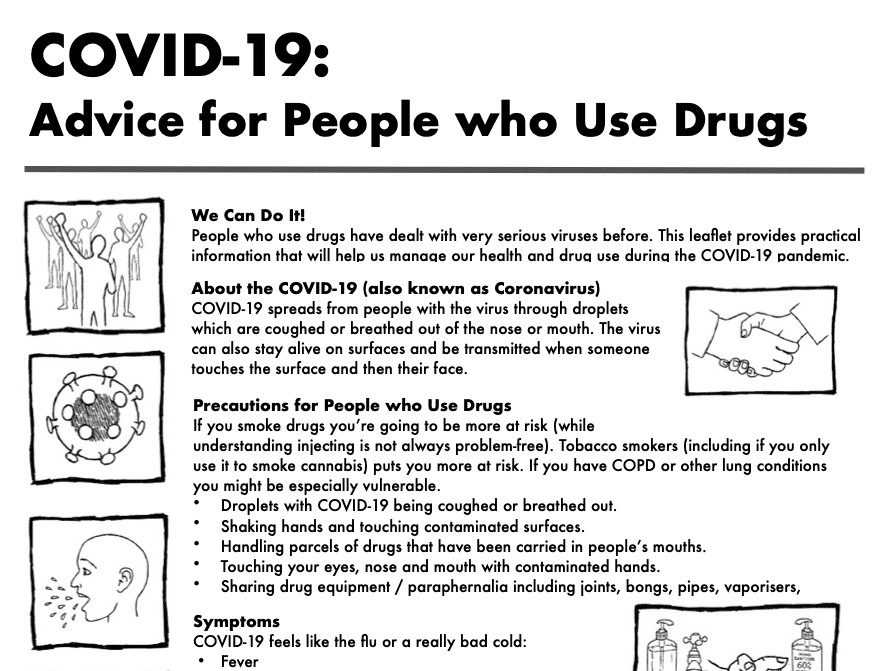
  • COVID-19: Advice for People Who Use Drugs

    COVID-19: Advice for People Who Use Drugs


    Click HERE for more resource

    Click HERE for French version

  • Shelters & Drop-Ins (General & COVID-19/Alberta Contexts)

    Shelters & Drop-Ins (General & COVID-19/Alberta Contexts)


    Click HERE for more resources

  • COVID-19: Information for OAT Prescribers and Pharmacists

    COVID-19: Information for OAT Prescribers and Pharmacists


    Click HERE for more resources

    On March 11, 2020, the World Health Organization declared the novel coronavirus, COVID-19, a pandemic, citing concern over alarming levels of spread and severity across the globe. The novel coronavirus has caused a global outbreak of respiratory infections since its discovery in December 2019. For most, this coronavirus causes only mild to moderate symptoms including fever and cough, however, older adults and those with existing health problems are at greater risk for more severe symptoms such as pneumonia.

    The situation regarding COVID-19 continues to evolve here in BC, Canada, and other jurisdictions in the world. Federal and provincial health officials have urged individuals on chronic medications to acquire an adequate supply of prescription drugs. Ensuring uninterrupted access to essential medications, including opioid agonist treatment (OAT) medications for patients with opioid use disorder, is of critical importance to reduce the risk of harms and death that can be associated with medication destabilization.

  • Prescriber Guidelines Risk Mitigation in Dual Public Health Emergencies

    Prescriber Guidelines Risk Mitigation in Dual Public Health Emergencies

    Click HERE for more resources

    People in the Downtown Eastside (DTES) are doing their part to reduce the transmission of COVID-19 by self-isolating; we need to do our part in supporting them. VCH has new guidelines in place to help prescribers support people who use drugs (PWUD) who need assistance managing withdrawal symptoms due to COVID-19.